
ELECTRONICS
All personal computers contain integrated circuits.
The program in a washing machine is controlled by electronics
Items at a checkout in a supermarket are scanned by a bar code reader.
Many cars are now made using remote controlled robots and run using an 'on-board' computer.
A very sensitive cot alarm has been made to follow the breathing of babies.
All amplifiers in radios, cassette recorders and televisions contain many electronic devices.
Cash cards and phone cards are scanned by electronic sensors.
Many books and newspapers are written using a word processor and you will find one of these machines in most modern offices.
If you book your holiday through a travel agent it is most likely that they will do it through a computer database.
Shopping can now be done "on line"
Mobile phones using either speech or text messages are an important part of everyday life
Email is used to transmit information round the world
The Internet is a vast source of information – you have used it to access these notes!
Many cars now have a GPS unit
These facts show you just how much
electronics affects our everyday lives. The enormous increase in electronic devices both for
communication and entertainment has had a huge impact on our lives in the late twentieth
and early twenty-first centuries. We are going to look at some experiments to help to
understand some of the electronic devices that you might meet although we will have to stick
to the simple ones!
INPUT DEVICES – SENSORS
Every
electronic circuit must have some kind of input device so that we (the outside world) can
"communicate" with it.
THE SWITCH
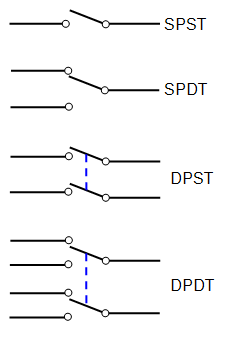
When the switch is closed it allows current to flow through
it.
TYPES OF SWITCH
There are various types of switches that can
do slightly different jobs in a circuit
SPST - sinqle pole, single throw
SPDT -
single pole, double throw
DPST - double pole, single throw
DPDT - double
pole, double throw
The diagrams show you examples of each
type.
STUDENT INVESTIGATION
Which switch would you use to:
(a) change the direction of an electric motor
(b) switch on a light
(c) switch off a green light and switch on a red light
(d) switch on two motors at once
THE LIGHT DEPENDENT RESISTOR
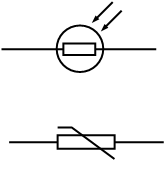
This is a resistor which has a resistance
that changes with the amount of LIGHT that falls on It. In the DARK its resistance is LARGE
(millions of ohms), in the LIGHT its resistance is SMALL (tens of ohms). Very little current will
flow through It In the dark.
THE THERMISTOR
This is a type resistor which has a resistance that changes
with TEMPERATURE. In the COLD its resistance is LARGE (thousands of ohms), in the
HEAT its resistance is SMALL (tens of ohms). Very little current will flow through it when it is
cold.
OUTPUT DEVICES – INDICATORS
Every electronic circuit
must have some kind of output device so that it can "communicate" with us (the outside
world).
THE LIGHT EMITTING DIODE – LED
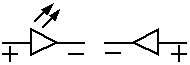
This is a diode that emits light when a current is passed
through it. lust like a normal diode it will only work one way round. The longer of the two connecting legs should be connected to the positive terminal of the voltage supply (battery). A protective resistor is
also usually placed in series with it.
THE BUZZER

This will make a noise when a current passes through it. Like
the diode the version we have only works if connected the correct way round. The current
needed to operate the buzzer is much larger than that needed to light the
LED.
THE RELAY

A small current passing through the coil will close a relay switch and so
allow a much larger current to flow in another circuit. The reed relay could also be closed by
holding a magnet next to it.
SMALL TORCH BULB

This is simply a small bulb that lights up
when a current is passed through it. The bulb works either way round and the bigger the
current the brighter the bulb.
Remember that for all these devices:
The bigger the resistance of a device the bigger the voltage drop across it.
In other words:
when its resistance is LARGE the output across it is HIGH (1)
when its resistance is SMALL the output across it is LOW (0)