

When you look into the two sides of the bowl of a spoon you
are actually using two simple curved mirrors. The side that curves inwards is called
CONCAVE and the side that curves outwards is called CONVEX.
It is the same with
mirrors, if the reflecting surface curves inwards you have a CONCAVE mirror and if the
reflecting surface curves outwards you have a CONVEX mirror.
Many curved
mirrors are parts of a sphere and so are known as SPHERICAL MIRRORS. The centre of
this sphere is called the CENTRE OF CURVATURE (C) of the mirror and its radius the
RADIUS OF CURVATURE (R) of the mirror.
The distance from the pole (P) to the
principal focus (F) is called the FOCAL LENGTH of the mirror. The principal focus and focal
length of a concave mirror are real but those of a convex mirror are virtual.
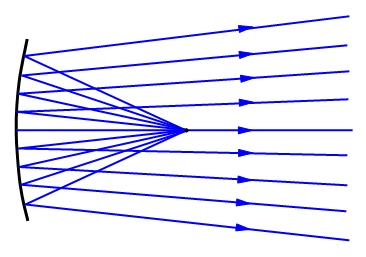
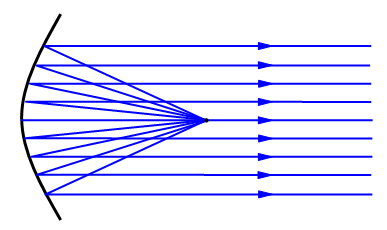
The
effect of the two types of curved mirror on a parallel beam of light is shown by the two
diagrams.
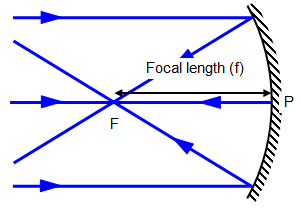
A concave mirror will converge a beam of
light and it gives a real image. However, if the object is closer to the mirror than its focal
length the image is virtual.
The focal length and
radius of curvature of a concave mirror are real.
The image produced is up the right
way, virtual and magnified if the object is closer to the mirror than its focal length but
inverted and real if it is further away.
Uses of concave mirrors
Shaving
mirrors, make-up mirrors, dentists' mirrors, microscopes, fun mirrors, lamp reflectors,
reflecting telescope.
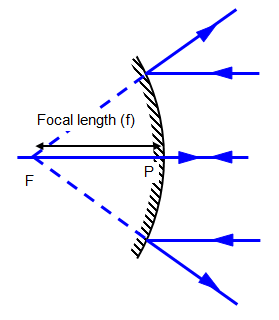 A convex mirror will diverge a
beam of light and it gives a virtual image.
A convex mirror will diverge a
beam of light and it gives a virtual image.A concave mirror is often used behind the bulb in a lamp, searchlight or projector to give a parallel beam of light but if the aperture of the mirror is too big the beam will spread out. For this reason parabolic mirrors are used, these have a slightly different shape to the spherical mirrors and will give a perfectly parallel beam. They are also used in all big reflecting telescopes because they give a much sharper image than a spherical mirror. (In the following diagrams the difference in the shape of the parabolic and spherical mirrors would be too small to see so both the spreading and the mirror shapes have been exaggerated!)