


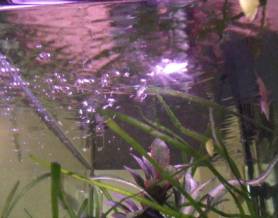
You can see this very easily if you float a weighted test tube in a beaker of water and then look down at the side of the test tube through the top of the water - you can't see into the tube and the side of it looks shiny. The same effect can be seen if you open your eyes under water and look up at the water surface from below. It is this effect that causes mirages and is used in the glass fibres of fibre optics.
When light hits the boundary between
glass and air or water and air it is usually refracted out but as the angle of incidence is
increased an angle is reached where the light emerges along the boundary - the angle of
refraction is 90o.
As the angle of incidence is increased the angle of refraction also
increases until the light emerges along the boundary between the block and the air (diagram
(b)).
The angle of incidence in the transparent material when this happens is called
the CRITICAL ANGLE.
The critical angle for glass is
42o.

Total internal reflection only happens when the light is travelling from the more dense material to the less dense i.e. glass to air, glass to water or water to air.

