Floating
The density of a material governs whether it will sink or float in
different liquids or gases.
An object floats in a fluid if its density is less than the density of the fluid.
So a wooden block floats in water while an
iron one sinks. A hydrogen-filled balloon will rise in the air but one filled with carbon dioxide
sinks to the ground.
This is best explained by Archimedes
principle.
When an object floats in a liquid the upthrust is equal to the weight of the object itself— the net force on the object is zero.

A floating object displaces its own weight of liquid.
A
ship will float because the weight of water displaced is equal to the weight of the ship. The
ship will sink deeper into the water until this is true.
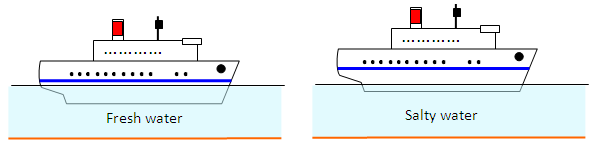
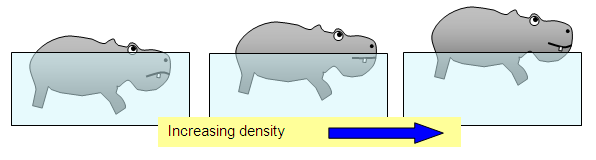
The density of the liquid is also very important. A
ship will float lower in low density fresh water than it will in higher density salt water. The
weight of liquid displaced each time is the same - the weight of the ship itself.
A VERSION IN WORD IS AVAILABLE ON THE SCHOOLPHYSICS USB