PRESSURE
People who wear stiletto heels are asked not to walk on soft floors
Snow shoes stop you sinking through soft snow
The lunar landers were fitted with large foot pads
Tractors that have to work on soft ground are fitted with wide tyres
The police can get an idea of heavy a burglar might be by looking at their footprints
When you use a car jack on soft tarmac put a flat board underneath it
Some buildings on soft ground are built on concrete rafts
There is a lizard that can run over the surface of water
These facts are examples of the effects
of PRESSURE between two surfaces. We can study these effects by the following investigations.
STUDENT INVESTIGATIONS
1. Take off your shoes and stand on the floor. Now spread some gravel on a sheet of newspaper on the floor and stand on the gravel. Which hurts more and why?
2. Hang an S hook with a 1 kg mass on it from the end of your finger. Now put a 1 p piece between the S hook and your finger. Which hurts more, with the coin or without the coin, and why?
3. Fill a flat tray with soft, damp sand and stand on the sand. How deep is the imprint that you make in the sand? Now put a block of wood on the sand and stand on the block and measure how far it sinks in.
4. Take off your shoes and stand on a piece of graph paper. Draw round done foot and use the graph paper to find the area of your feet in cm2. Use a weighing machine to measure your mass.
5. Hold a pencil with a sharp point between your finger and thumb. Press. What do you feel and why?
These simple experiments
should have shown you that:
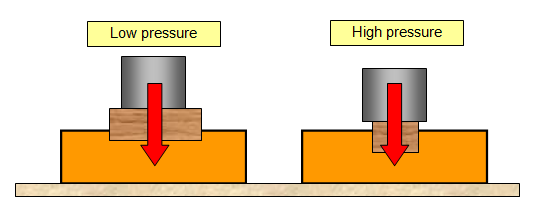
The bigger the force (weight) and the smaller the area the greater the pressure
THEORY

The pressure between two solid surfaces depends on two
things:
(a) the force between the surfaces
(b) the area of contact between the two
surfaces.
The greater the force or the smaller the area the greater the pressure.
Pressure = Force between two surfaces/Area of contact P = F/A
The units for pressure are Newtons per square metre (N/m
2), now called Pasals
(Pa) ( 1 N/m
2 = 1 Pa). You can also use Newtons per square cm
(N/cm
2).
Example problems
1. A boy of weight 500 N has feet with a total area of 200 cm2. What is the pressure between him and the ground if he stands on both feet?
Pressure = Force/Area = 500/200 = 2.5 N/cm2
2. The pressure between a car tyre and the road is 100 000 N/m2. If the car has a weight of 10000 N what is the area of contact between the tyre and the road?
Area = Force/Pressure = 10 000/100 000
= 0.1 m2.
3. The pressure in a boiler is 20 000 N/m2. If the area of one end is 0.6 m2. What is the force on that end?
Force = Pressure x Area
= 20 000 x 0.6 = 12 000 N
STUDENT INVESTIGATIONS
Devise and carry out experiments to measure:
(a) the normal pressure between a drawing pin point and a piece of wood
(b) the pressure between a cats paw and the ground and between a horse's hoof and the ground
(c) the pressure between a twenty storey building and the ground
(d) the pressure between a ball point pen and a piece of paper when you write
(e) the pressure between your feet and the ground using the results that you got from the previous set of experiments
Examples of HIGH PRESSURE
the
point of a drawing pin, stiletto heels, running spikes, chair legs and the ground, a nail point, stilts,
thin rucksack straps, cheese wire
(these are concentrated forces)

Examples of LOW PRESSURE
skis,
caterpillar tracks, snow shoes, head of a drawing pin, large tyres and the ground, wide rucksack
straps
(these are "spread out" forces)

A VERSION IN WORD IS AVAILABLE ON THE SCHOOLPHYSICS USB