

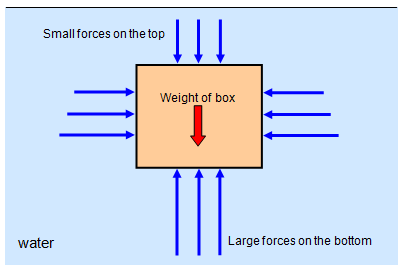
When an object is put into water (or any other liquid) there are forces on the object due to the liquid. The deeper down in the liquid you go the greater these forces are. The density of the liquid also affects the forces on the object - the greater the density the greater these forces are. Therefore both the depth in the liquid and its density will affect the upthrust on an object.
You can
see from the drawing that the pairs of forces on the two sides of the box are equal and so
cancel out but the forces on the bottom of the box are greater than those on the top. This
means that there is a difference between the forces on the top and those on bottom of the
box.
The resulting force on the bottom of the box pushes it upwards and this is
called the UPTHRUST on the box.
The upthrust on an object stays the same no
matter how deep it goes (as long as it is completely submerged). This is because the
upthrust depends only on the DIFFERENCE between the forces on the top and bottom of the
object.
If the upthrust on the object is bigger than its weight the object rises, some of
it comes out of the water until the upthrust is equal to its weight and the object
floats.
If the upthrust on the object is smaller than its weight the object sinks to the
bottom of the liquid.
Upthrust is defined as the upward force on the object provided
by the liquid because the object has "displaced" some of the fluid. The volume below the
water level that is now occupied by the object used to be filled with water and if the object
has a different density than water there will be an upward force on the object. If this force is
less than the weight of the object the object will sink.