The structure of the atom
As you know atoms are very small but every atom has even
smaller particles inside it.
All atoms consist of two parts:
(a) a central heavy NUCLEUS
that contains
(i) PROTONS – particles with a unit positive charge
(ii) NEUTRONS -
neutral particles with a mass slightly greater than that of a proton
(b) ELECTRONS orbiting the
nucleus. These are particles with a negative charge, equal and opposite to that of a proton. They
have a mass about 1/1860 of that of a proton.
We really ought to explain what we mean by
light and heavy here.
You would need 1000 million million million million protons or neutrons to
have a mass of one kilogram. This may seem a huge number but you would need almost 2000
times as many electrons to have the same mass!
The diagram below shows a simplified
picture of the structure of an atom
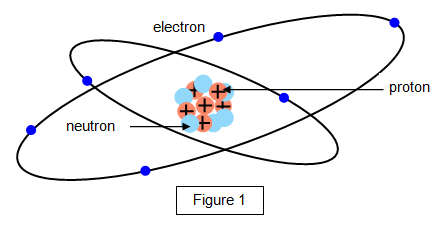
Atoms are also very small. We can think of an atom as a tiny sphere about a
hundredth of a millionth of a centimetre in diameter.
This means that 10 thousand million
atoms could be laid side by side along a one metre rule!
The number of PROTONS in the
nucleus tells us what element the atom is:
If there are six it is carbon
If there are eight it is
oxygen
If there are twenty-six it is iron
If there are ninety-two it is uranium
For
normal atoms the number of protons is balanced by an equal number of orbiting electrons - this
makes the atom as a whole neutral.
Atoms are neutral particles - they have no net charge
There
are also neutrons in the nucleus of all atoms except the simplest form of
hydrogen.
The total number of NEUTRONS and PROTONS in a nucleus is called the NUCLEON NUMBER or MASS NUMBER
The number of PROTONS in the nucleus is called the PROTON NUMBER or ATOMIC NUMBER
The number of NEUTRONS in the nucleus is called the NEUTRON NUMBER
We use a special way of
writing the structure of a nucleus so that is easy to see what the proton and nucleon numbers
are.
This is how to write down the structure of carbon and
uranium:

This means that in the
nucleus of a carbon atom there are 6 protons and 6 neutrons making 12 particles (or nucleons). In
a uranium atom there are 92 protons and 146 neutrons making 238 nuclear particles
(nucleons)
You will find a list of the structure of some of the more common elements in
the data section.
The diagrams below show the structure of a few of the lighter atoms.

A VERSION IN WORD IS AVAILABLE ON THE SCHOOLPHYSICS USB