

When one or more electrical components are
joined together to a cell it is called a circuit. Electricity will not flow if there are any breaks in this
circuit.
In a metal wire there are millions upon millions of free electrons, tiny negative
charges, buzzing around randomly in all directions. If we connect a cell battery between the two
ends of the wire these electrons will drift towards the positive terminal. This flow of free electrons is what we call an electric
current.
An electron is such a tiny amount of charge
that we use a bigger unit when studying actual electric currents. The amount of electrical charge is
measured in units called coulombs.
The electric current in a circuit is measured in Amps
using an instrument called an ammeter.
| Appliance | Current flowing through it |
| Light bulb ('average brightness' 100 W) | 0.5 A |
| Electric torch | 1 A |
| Washing machine | 1 A |
| Television | 1.5 A |
| Electric kettle | 4 A |
| Mains immersion heater | 13 A |
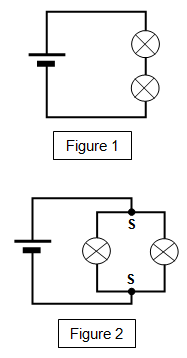 If you have a
battery and two bulbs there are two ways of connecting them to make a
circuit:
If you have a
battery and two bulbs there are two ways of connecting them to make a
circuit:(b) in PARALLEL - the
bulbs are connected side by side.
The current SPLITS AT THE JUNCTIONS (S), some going
one way and some the other.
If the bulbs are exactly the same then exactly the same current
will flow through each bulb (see Figure 2)
If the batteries and
bulbs in both circuits are the same then:
(a) the bulbs in the parallel circuit will be brighter than
those in the series circuit
(b) the battery in the parallel circuit will run down quicker than the
one in the series circuit