Mathematics
This section contains some useful mathematics for the
14-16 level Physics section
1. Powers of ten
| tera |
1 000 000 000 000 |
1012 |
|
8 000 000 000 000 |
8x10¹² |
|
2 500 000 000 000 |
2.5x10¹² |
| giga |
1 000 000 000 |
109 |
|
8 000 000 000 |
8x10⁹ |
|
2 500 000 000 |
2.5x10⁹ |
| mega |
1 000 000 |
106 |
|
8 000 000 |
8x10⁶ |
|
2 500 000 |
2.5x10⁶ |
| |
10 000 |
104 |
|
80 000 |
8x10⁴ |
|
25 000 |
2.5x10⁴ |
| kilo |
1 000 |
103 |
|
8 000 |
8x10³ |
|
2 500 |
2.5x10³ |
| |
100 |
102 |
|
800 |
8x10² |
|
250 |
2.5x10² |
| |
10 |
101 |
|
80 |
8x101 |
|
25 |
2.5x101 |
| |
1 |
100 |
|
8 |
8x100 |
|
2.5 |
2.5x100 |
| |
0.1 |
10-1 |
|
0.8 |
8x10⁻¹ |
|
0.25 |
2.5x10⁻¹ |
| centi |
0.01 |
10-2 |
|
0.08 |
8x10⁻² |
|
0.025 |
2.5x10⁻² |
| milli |
0.001 |
10-3 |
|
0.008 |
8x10⁻³ |
|
0.0025 |
2.5x10⁻³ |
| |
0.0001 |
10-4 |
|
0.0008 |
8x10⁻⁴ |
|
0.00025 |
2.5x10⁻⁴ |
| micro |
0.000 001 |
10-6 |
|
0.008 |
8x10⁻⁶ |
|
0.0025 |
2.5x10⁻⁶ |
| nano |
0.000 000 001 |
10-9 |
|
0.0008 |
8x10⁻⁹ |
|
0.000 000 0025 |
2.5x10⁻⁹ |
| pico |
0.000 000 000 001 |
10-12 |
|
0.000 000 000 008 |
8x10-12 |
|
0.000 000 000 0025 |
2.5x10⁻¹² |
2. Division by decimals
8/0.1 = 80 6.7/0.1 = 67 50/0.2 = 250
24/1.2 = 20 4/0.001 = 4000
3. Algebra
Pythagoras'
theorem
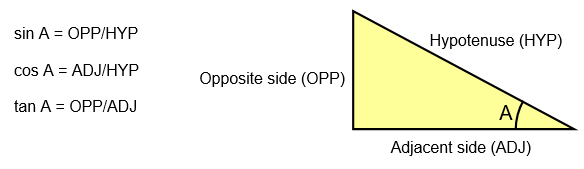
For a right angled triangle: (HYP)
2 = (OPP)
2 +
(ADJ)
2 (see the triangle below).
Solving a quadratic equation:
ax
2 + bx + c = 0
The roots of this equation are: [-b +/-square root(b
2
– 4ac)]/2a
The equation of a straight line is: y = mx + c where m is the gradient
and c the intercept on the y axis.
a(b – c) = ab – ac
4.
Trigonometry
5. Changing the subject of an
equation
We meet lots of equations in Physics. What looks like different equations
may sometimes be the same equation written in a number if different ways.
For
example: V = IR is the same as I = V/R and R = V/I
This is known as changing
the subject of the equation or rearranging the equation.
If we start with V = IR and want
to find what I is (in other words we need to make I the subject of the equation) then we must
first divide both sides by R.
So V divided by R is V/R, IR divided by R is just I and so I = V/R.
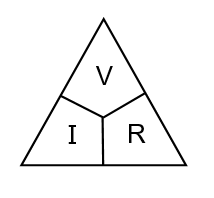
You can also use the so-called "magic triangle".
The same example is
shown for you.
The top letter is found by multiplying the two lower
letters.
Either of the two lower letters is found by dividing the top letter by the other lower
letter.
6.Formulae
A little explanation of what formulae actually
mean.
(a) If something is written as IR it means I x R
This means exactly the
same as RI
So the formula for electrical energy can be written as VIt or IVt or ItV.
They all come to the same thing when numbers are put in.
(b) If something is written
as at
2 it means a x t x t
So the formula for kinetic energy ( ½ mv
2)
means ½ x m x v x v.
(c) if something is written as [v – u]/t it means that you subtract
u from v and then divide the answer by t.
7. Useful areas and
volumes
Area of a circle =
pr
2Area of the
surface of a sphere? = 4
pr
2Volume of a sphere? = 4/3
pr
3Volume of a rectangular solid = length x width x height
Area of
a triangle = ½ base x height
A VERSION IN WORD IS AVAILABLE ON THE SCHOOLPHYSICS USB