Elasticity
A rubber band will stretch if you pull it
Elastic is used to keep some of your clothes on
Rubber car tyres give you a comfortable ride
Fishing line will break if tugged too hard
You can sleep well on a bed that has good springs in it
Many ballpoint pens have springs in them
Bouncing on a trampoline is fun
If you drop a piece of putty on a concrete floor it does not bounce
A glass beaker will shatter if it is dropped but an aluminium one will bounce
Playing squash with a golf ball would be difficult
All these
effects are connected to the elastic properties of materials.
Some materials will
stretch easily while others are very strong. Some are flexible while others are brittle – they
break without "giving". The use of different materials for different jobs depends on the elastic
properties of a material.
One effect of a force on an object is to change its shape or
size. The property of the material of the object that governs just what change will take place
is called the ELASTICITY of the material.
Some materials are affected a lot
by a force e.g., rubber, while others change their size very little e.g., steel. We are thinking
here about pieces of equal size, of course.
Hardness
Another
important property of materials is their hardness. The following table shows the relative
hardness of a number of materials. Ones which are hard will scratch ones that are softer.
| Substance |
Hardness |
Substance |
Hardness |
Substance |
Hardness |
| Agate |
6-7 |
Chromium |
9 |
Penknife blade |
6.5 |
| Aluminium |
2-3 |
Concrete |
6-7.5 |
Sand |
10.5 |
| Amber |
2-2.5 |
Copper |
2.5-3 |
Silicon carbide |
13 |
| Asbestos |
5 |
Diamond |
15 |
Silver |
2.5-2.7 |
| Brass |
3-4 |
Finger nail |
2.5 |
Steel (mild) |
4-5 |
| Calcium |
1.5 |
Glass |
4.5-6.5 |
Tungsten carbide |
8.5 |
| Carborundum |
9-10 |
Marble |
3-4 |
Wood |
1.5-4.5 |
Elastic and plastic materials
You can divide materials into two
main types when you consider their elastic properties:
(a) those which will go back to
their original length when the force is removed after stretching, these are called
ELASTIC
materials such as steel and rubber
(b) those which stay stretched after the force is
removed- these are called
PLASTIC materials such as putty or plasticene
We use
elastic materials in our lives in a variety of ways:
Elastic in our clothes, elastic bands,
springs in watches, beds, ball point pens, cars and trampolines to name just a few. You can
probably think of others.
Hooke's Law
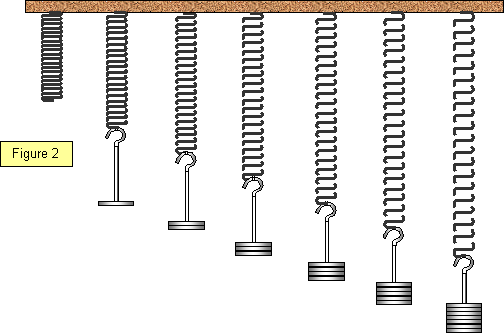
The more force that is put
on to a piece of elastic or a spring the more it will stretch.
If you plot the extension
against the force applied to a copper wire or a steel spring you will get a graph like the one
drawn in Figure 1.
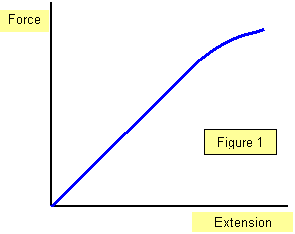
As the force is
increased so the length of the sample increases and so the extension gets bigger. You will
find that for every Newton increase in the force the length of the sample will increase by the
same amount.
The extension is directly proportional to the force applied.
Force = constant x extension
This is known as Hooke’s Law.
If you stretch
an elastic material too much it will not go back to its initial size and if it is stretched even
more it will break.
Example problems
If a load of 5 N extends a spring by 4 cm then a load of 15 N will extend it by 12cm.
Remember that it is the extension that is proportional to the force and NOT the total length of the spring.
You can compare how much different materials
will stretch using the following table. This shows the relative extensions for samples of the
same length and diameter but of different materials using the same force.
| Material |
Extension |
Material |
Extension |
| Diamond |
1 mm |
Concrete |
59 mm |
| Steel |
5 mm |
Beech |
67 mm |
| Copper |
8 mm |
Oak |
91 mm |
| Cast iron |
9 mm |
Pine |
83 mm |
| Aluminium |
14 mm |
Plastic |
500 mm |
| Granite |
20 mm |
Nylon |
500 mm |
| Lead |
56 mm |
Rubber |
500 m |
| Bone |
56 mm |
100 |
100 |