

Car safety
The main idea of car safety is to bring the
passengers to a stop in the longest possible time and the in longest possible distance.
Then, if and when they hit something to make the damage it does to them as little as
possible.

Car
design
Slowing down slowly:
(a) crumple zones in the car body
(b)
seat belts
(c) air bags
Less damage
(a) laminated windscreens
(b)
no hard projections in the car
(c) collapsing steering wheels
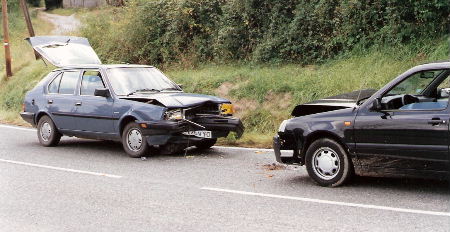
You can see
the effect of crumple zones in the photograph of the car crash. Although the bonnets of
the two cars are badly damaged, in fact both car were a write off, the passenger
compartments are unaffected and all the passengers got out safely and without
injury.
Being able to stop at all and in a controlled way needs:
(a) good
brakes
(b) good tyres
Weather
Weather conditions are also
important. It will obviously take longer to stop if there is less friction between the tyres
and the road in wet or icy conditions and if it is foggy the driver will not be able to see a
problem ahead until it may be too late to stop. Therefore in poor conditions people
should always drive more slowly.
The driver
Of course all this is
no good unless the car is driven safely, within the speed limit for the road and by a driver
who is alert for any possible happenings around them.
The alertness of the
driver will be seriously affected by the use of drugs and alcohol. The reaction time of
someone who is drunk or under the effects of drugs is much longer and the driver cannot
drive safely! Also tired drivers are not safe drivers, so people who drive long distances
should have regular rests and even those on short journeys who are tired should take
extra care.
Attempting to do something else while you are driving means that
you are not fully aware of what is happening around you on the road. Therefore drivers
in cars should not use mobile phones; drivers should not read, eat or drink or get so
involved in conversations that they lose concentration.
It only needs a split
second of misjudgment to cause a serious accident.
Speed limits
and speed cameras

Speed
can be a factor as important as many of the others in road safety. In 2003 just over
3,500 were killed on Britain's roads. Some of these died because of alcohol, some were
pedestrians and some died simply because people driving the car or lorry involved in the
accident were just going too fast. I have been passed on the motorway when driving at
just seventy mph by people who were probably doing 100 mph. At these speeds your
judgment of distance is much more critical – we don't all have the training of formula one
car drivers!
At 70 mph in good road conditions you can stop in but if you are
travelling at 100 mph it would take 196 m – over twice as far! Next time you play soccer,
rugby or hockey take a look at the length of the pitch – a driver moving at 100 mph
would take the length of two pitches to stop. (Image: Freephoto.com)
Speed
cameras and speed limits are put on roads to try and keep people to sensible safe limits
in places where the accidents are likely to happen. Rural roads are especially dangerous
– people think that there is little traffic and so go faster than they should. Motorways are
dangerous if there is an accident because people coming up from behind pile into the
first crash because they are going too fast to stop.


Have a look at some roads near your school
where there is a speed limit and/or a speed camera and try and suggest reasons whey it
was put there.