

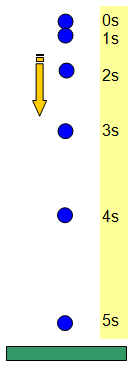
All these effects are connected with GRAVITY. Gravity is the force that pulls us to the ground and we usually call this force our weight. Without gravity we would be weightless. Gravity makes things accelerate if they are dropped. If a stone was dropped from a high building on the Earth its velocity would be about 10m/s after falling for 1 second, about 20 m/s after two seconds, about 30 m/s after three seconds and so on. (We will ignore the effect of the air for the moment). The acceleration produced by the pull of gravity is given the symbol g. Near the surface of the planet Earth the velocity of a falling object increases by about 10 m/s every second it falls - its acceleration is therefore very close to 10 m/s2.
The pull of gravity is not the same all over the Earth. The further you get from the surface, up OR
down, the smaller the pull of gravity is - and you would feel lighter. The Earth is also not quite
round - it looks a bit like a soccer ball that someone has sat on - it is bigger round the equator than
round the poles.
On the Moon the pull of gravity is much less because the Moon is much smaller and less massive
than the Earth. In fact on the Moon you would only weigh about one sixth of what you do on Earth,
the pull of gravity is six times smaller. The pull of gravity is a good guide to the type of animals
living on a planet. A large pull of gravity would require the animals to have very strong skeletons to
support their own weight while the opposite would be true for planets with a low gravity pull.

Of course the air does slow things down when they fall through it. Think about a parachute - it has
a lot of air resistance (often called drag) and it therefore falls slowly. This air resistance is much
more noticeable for a spacecraft entering the upper atmosphere - the drag here is so great that the
craft has to be protected by heat resistant tiles otherwise the heat produced by the air friction
would melt it!
It's not the weight of something that matters but its surface area. Try dropping a sheet of paper
and see how long it takes to get to the floor. Now screw it up and try again - there is less drag this
time and so it falls quicker. A free fall parachutist can reach 125 mph lying flat out but nearly 200
mph head down!
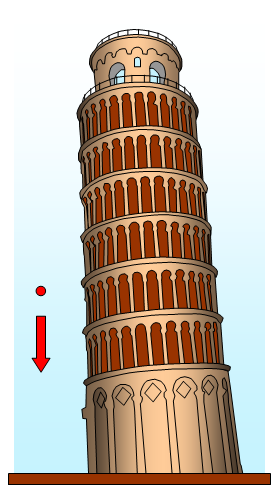
There is a story that Galileo tried to test whether all objects would fall at the same rate (if we took away the air). He was supposed to have dropped two balls, one heavy and one light, from the top of the leaning tower of Pisa watched by an interested crowd. To the spectators amazement they both reached the ground at the same time. In fact he probably never did this and anyway the effects of air resistance would have affected the results too greatly for it to be a very fair test.
However we can test Galileo's ideas more carefully by dropping a feather and a penny down a glass tube. When the tube is full of air the penny reaches the bottom first but when the air is pumped out they both reach the bottom at the same time. The Apollo astronauts have done a similar experiment on the Moon but since there is almost no air there they didn't need an evacuated tube. When something falls through a fluid (this can be a gas such as air or a liquid) it does not go on getting faster and faster. If it is falling through air the friction with the air slows it down. The maximum velocity that an object can reach in a given fluid is called its TERMINAL VELOCITY. Remember that the greatest terminal velocity for a person falling through air near sea level is about 200 mph head down and about 125 mph lying flat out.
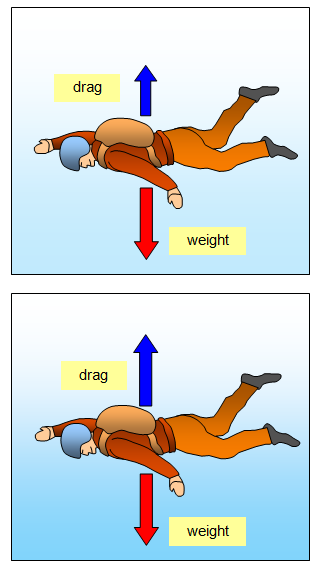
Lets think about a free fall parachutist stepping out of a plane and falling down through the air. At
first they are moving slowly downwards but their speed soon increases but so does the drag (air
resistance) on them.
Eventually they are falling at their terminal velocity at this point the drag is
equal to their weight. If they now open their parachute their weight stays the same but the drag
gets much greater and so their speed drops until weight = drag again.
A certain person's terminal velocity will be different at different altitudes because of the different density of the air. The record free fall parachute jump at present was from around 30 000 m and the person fell over 10 000 m before opening their parachute. At these altitudes the terminal velocity is close to the speed of sound!