Momentum
A girl can throw a 600g javelin 20m but can only throw a 900g javelin 15m.
The world record for the men’s shot put (using the 7.5kg) shot would be much further if they used the 5kg shot.
A small car would accelerate much faster if it were fitted with a 3.5 litre engine
A heavy man would depress a trampoline bed much more than a light boy.
The greater the force you apply to an object (say a shot)
and the longer you apply this force for the greater will be the change of velocity of the object.
However something else affects this change in velocity. Think about what happens if you try
and throw a heavier shot?
Even if you use the same force for the same time it
is obvious that you wont be able to throw a heavy javelin as fast as a light one and so
it won't go so far.
To find out the change in velocity we must use the idea of
MOMENTUM.
Momentum = mass x velocity
If we apply a
certain impulse to an object we will get a certain change of momentum. The velocity change
depends on the mass of the object:
Impulse = change of momentum
or: Ft = mv - mu
where u is the initial velocity and v the final velocity.
The
units of momentum are the same as those for impulse, that is Newton seconds
(Ns).
If we think of an object at rest either before or after an impulse is applied to it,
then the impulse becomes either
(a) something that gives a stationary object a
momentum, or
(b) something that takes the momentum away from a moving
object.
The formula can be rewritten as:
Ft = mv
where v is the velocity gained or lost. From this formula
you can see that for a given
momentum you either need a large force acting for a short
time or a small force acting for a long time.
We can use the idea
of momentum and impulse to work out the change of speed of an object when a certain
impulse acts on it.
Example problem
We want to give a cricket ball a momentum of 4.8 Ns. We can do this in many ways but here are two examples.
(a) force 48N time= 1s Ft = 4.8 x 1 = 4.8 Ns Large force for a short time
or
(b) force = 2N time = 2.4s Ft = 2 x 2.4 = 4.8 Ns Small force for a longer time
If the cricket ball has a mass of 0.16 kg calculate the velocity of the ball if it started from rest.
Momentum change = mv = impulse = 4.8 Ns
Velocity = 4.8/0.16 = 30 m/s
You can
feel this if you try to stop an object moving. If you catch a cricket ball with your hands still it
will hurt, you are stopping it in a very short time and so the force will be large. However, if
you let your hands give it makes the time longer and so the force will be smaller.

A fun demonstration of the effect of the time of
stopping on the force used to stop is to use eggs! First throw them into a hard wall and then
into a sheet that is being held vertically by two people. The sheet will give – the eggs will
slow down slowly and won't break!
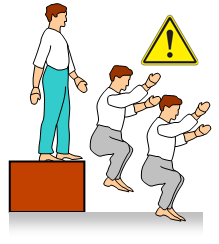
When you jump off a wall onto the ground you
should always bend your knees on landing. If you did not you would be trying to stop
yourself in a very short time and the force on you would be very large.
Don't try this
as you may seriously damage your back.
(Note: A very good video clip of people
jumping off a stool onto the ground is shown in the Multimedia Motion II CD produced by Cambridge
Science Media)
Think about how momentum and impulse apply to the following
cases:
Iron cricket bats or hockey sticks, the design of rigid or squashy car bumpers.
Example problems
A boy of mass 50kg jumps off a wall and hits the ground with a velocity of 5 m/s. What is the force of the ground on him if:
(a) he bends his knees and lands in 0.5 s and
(b) if he does not and lands in 0.05 s?
(a) Ft = 50x5 = 250 Ns
F = 250/0.5 = 500 N
(b) Ft = 250Ns F = 250 /0.05 = 5000N
Momentum and direction change
A rubber ball will bounce up if you drop it on the, floor.
A lump of putty of the same mass dropped from the same height will not bounce.
Which has the
biggest change of momentum? Actually the rubber ball because it has had its
DIRECTION
of motion changed. Momentum is a vector quantity like velocity.
Example problems
1. A 500g lump of putty is dropped so that it hits the floor at 3m/s and stops. What is the change of momentum?
Change of momentum = 0.5x0 - 0.5x3 = - 1.5Ns. (Notice that it is negative - the putty is slowing down.)
2. A 500g rubber ball is dropped so that it hits the floor at 3 m/s and bounces back at 2m/s. What is its change of momentum?
Change of momentum 0.5x2 - (- 0.5x3) = 2.5Ns (Notice the minus sign before the second momentum since it was moving the other way.]
A VERSION IN WORD IS AVAILABLE ON THE SCHOOLPHYSICS USB