POWER
Some cars are more powerful than others
That car is not powerful enough to pull a caravan
He is a very powerful rugby player
I need a more powerful light bulb so that I can see to read
It's too hot in here - the heater is too powerful
That singer has a very powerful voice - it's deafening
All these statements are about
power - but what is power? We can find out by thinking about something that we know well -
ourselves.
Imagine that we have a heavy sack and that we ask all of your
class to lift it to the top of a flight of stairs using a rope over a pulley. One person may take 10 s to
do it, another 12 s and someone else may only get it half way up in 20 s! Everyone who gets the
sack to the top has given it the same amount of gravitational potential energy (mass of sack x
gravity x height raised) but some people have taken a LONGER TIME than others to give it this
energy.
The POWER of each person depends on:
(a) how much energy they give the
sack
(b) how long they took to give it this energy
The more powerful a person, or any
machine the less time they take to convert a given amount of energy from one from to another and
so the shorter time they take to lift the sack in our example.
We can define power as:
Power is the RATE at which work is done and energy converted from one form to another.
Written as a formula
this is:
Power = work done/time taken = energy converted/time taken
the units
for power are joules /second or WATTS.
1 joule/second = 1 watt
Larger
powers are measured in kW or MW
1 kilowatt (kW) = 1000 W
1 Megawatt (MW) =
1000 000 W
If an electric motor has a power of 500 W and is used to lift a load it means
that it converts 500 J of electrical energy to kinetic, potential, heat and sound energy every
second.
A human can work at about 90 W all day but can operate at nearly 500 W for short
periods of time. However we are not very efficient and a lot of the energy created in our bodies is
wasted as excess heat.
Some examples of power of various things:
An average light
bulb 100 W
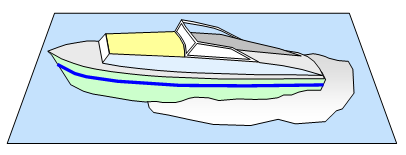
Power boat 100 kW
A boy of fifteen 600 W
Coach 250 kW
A family car
40 kW
Human heart 1 W
A large power station
1000 MW
Human brain 20 W
Power used to be
measured in horsepower; in fact the first experiments on power were done with horses.
1 horse power = 746 W
The power of a
strong horse is actually about two horse power. They must have used weak horses to work it out
initially.
Example problems
1. A boys lifts a 25 kg sack 6 m in 5 s using a pulley. What is his output power?
Power = [25 x 10 x 6]/5 = 1500 = 300 W
2. A crane has a power of 2 kW. How long will it take for it to lift a load of 200 kg a distance of 6 m?
Energy used = 200 x 10 x 6 = 12 000 J
Power = Energy used/ Time taken
Time taken = Energy used/ Power = 12000/ 2000= 6s
A VERSION IN WORD IS AVAILABLE ON THE SCHOOLPHYSICS USB