

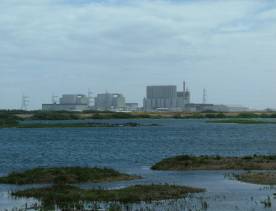
Nuclear power stations produce
nuclear waste that must be stored safely for long periods of time – sometimes up to many
thousands of years, and are also expensive to build. However they do not give off any
'greenhouse gases'.
The UK currently produces about 9000 MW using nuclear power and is now more of less committed to a starting a new nuclear power
station building programme and the new reactor at Hinckley Point (Hinckley C) has now been given the 'go ahead'. (September 2016)
The photograph shows the nuclear power
station at Dungeness in southern England.
Fossil fuelled (gas, coal, oil) power stations are less expensive to build but produce carbon dioxide – a greenhouse gas – when the fuel is burnt.
These are made by building a large dam across a river estuary such as
the one at La Rance in France producing 240 MW of power from 24 turbines. These turn as
the tide ebbs and flows and water passes through them. Much research has gone into
studying a possible barrage across the River Severn in England.
There are
considerable environmental problems about flooding estuaries upstream from the dam of a
tidal power station.
Wave power stations have not yet been developed on a large scale. However the world's first commercial 'wave farm' is already operating off the coast of Portugal and a wave farm is being built in Scotland that will generate 3 MW from four Pelamis wave machines. These machines convert some of the energy from the waves into electricity.
In a solar power station a large array of mirrors directs the sunlight onto a boiler where water is converted into steam. Recently a very large solar power station has been opened near Seville in southern Spain. It has 600 mirrors, each of 120 square metres that direct the sunlight onto the boiler at the top of a tower 40 storeys high (115 m). At present the power station operates at 11 MW – producing enough energy for 6000 homes. However it is claimed that it will eventually be able to supply energy for the whole of Seville's 600 000 inhabitants.
Hydroelectric power stations use the potential energy stored in lakes to generate electricity. This is only really practical in mountainous regions or where a river can be dammed. The disadvantage of this is that the lake may well have a large effect on the ecology of the region and may even cause the population whole villages to be re- housed.
These power stations, such as the one at Dinorwic in Snowdonia, produce electricity from water falling down a pipe rather like hydroelectric power stations. However the water that falls down in the daytime is pumped up over night when the demand for electricity is low and so can be 'used again' the following day.
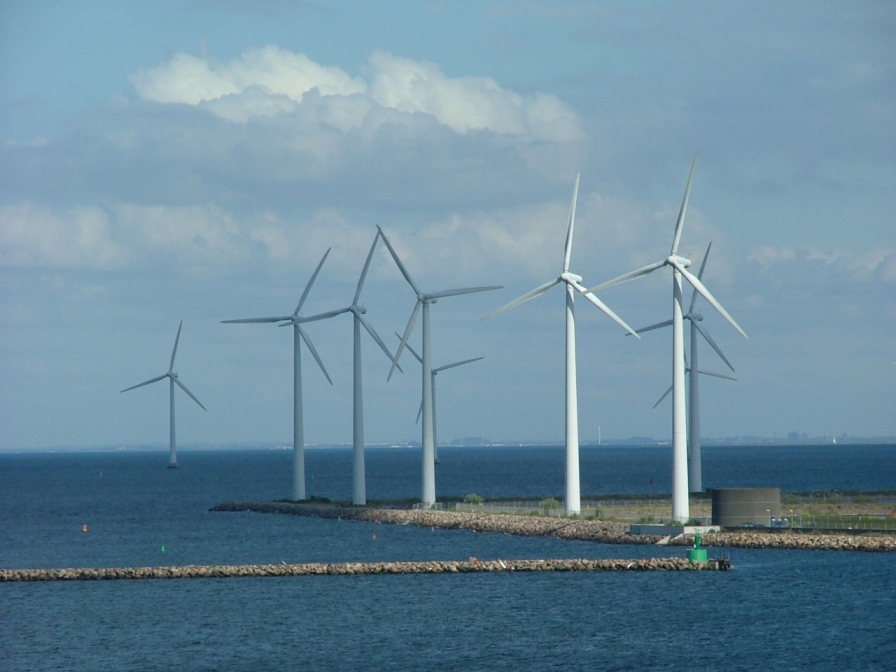
Wind power is used to produce
electricity from large wind turbines. The turbines are arranged in groups called
'Wind farms' many of these being in off-shore locations. By 2016 wind power produced 17% of the electricity required in the UK. This waas generated by nearly 7000 turbines generating 15 gigawatts of power (33% of this being off-shore).
Each turbine has three blades
and rotates at between 10 and 30 revolutions per minute depending on the wind speed. One
of the 'problems' with wind turbines is that they are rather large - they can be up to 140 m
high (including the tower on which they rotate).