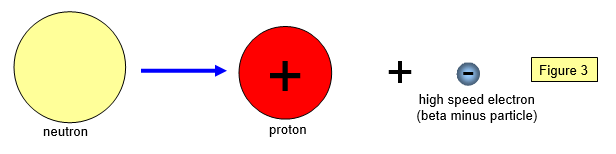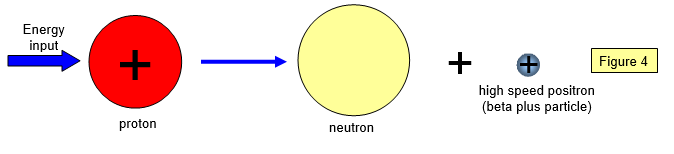


The problem is – how can
electrons be emitted from the nucleus when there are no electrons the in the first place? We
need to look at what is actually happening inside the nucleus to give us this emission of high-
energy electrons (beta particles).
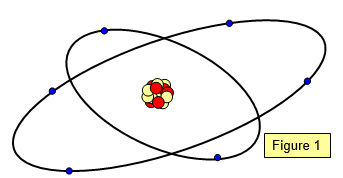
The first diagram (Figure 1) shows a carbon atom
(carbon 14). This atom has six electrons orbiting round a nucleus that is made up of six
protons and eight neutrons but no electrons.
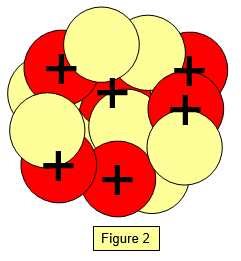
Figure 2 shows an enlarged view of the nucleus. The red circles
represent protons (positive charge) and the pale yellow circles represent neutrons (neutral –
no charge).
In some nuclei the conditions are just right for a neutron to decay onto a
proton and a high-speed electron (a beta particle). This is how beta particles can come from
the nucleus.
Because the neutron is negative and the proton is positive the negative
charge of the electron is 'needed' to balance the charges in the decay. A diagrammatic form
of this is shown in Figure 3. The neutron is slightly heavier than the proton so it is shown a
little bigger.