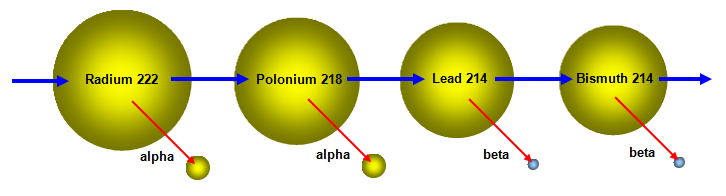


When a radioactive nucleus decays another
nucleus is formed. This new nucleus (called a daughter product) is often radioactive itself. It
then decays again and again until finally a stable nucleus is reached. This process is called a
decay series or a decay
chain.
One of the most well known is the decay series that starts with
uranium 238. It is particularly interesting because it includes radon 222 that is the radioactive
gas that is responsible for about 50% of the radioactivity that we receive as background
radiation.
| Isotope | Particle emitted | Half life |
| Uranium 238 | alpha | 4 500 million years |
| Thorium 234 | beta | 24 days |
| Protactinium 234 | beta | 1.2 minutes |
| Uranium 234 | alpha | 250 thousand years |
| Thorium 230 | alpha | 80 thousand years |
| Radium 226 | alpha | 1620 years |
| Radon 222 | beta | 1.2 minutes |
| Polonium 218 | alpha | 3.1 minutes |
| Lead 214 | beta | 27 minutes |
| Bismuth 214 | beta | 20 minutes |
| Polonium 214 | alpha | 0.00016 s |
| Lead 210 | beta | 19 years |
| Bismuth 210 | alpha | 250 thousand years |
| Polonium 210 | beta | 5 days |
| Lead 206 | stable |
To help you understand the table have a look at radon 222. It has a nucleus containing 86 protons and 136 neutrons. It emits an alpha particle (2 protons and 2 neutrons) and becomes a polonium 218 nucleus (84 protons and 134 neutrons). The polonium then emits an alpha particle to become lead 214 (82 protons and 132 neutrons). This emits a beta minus particle (an electron) to become bismuth 214 (83 protons and 131 neutrons) and so on down the series.