

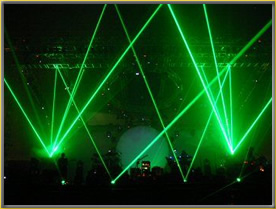
Electromagnetic radiation is the general name given to a whole family of
waves ranging from gamma rays to radio waves.
(See: Electromagnetic
spectrum)
The main types of electromagnetic waves are gamma rays, X rays, ultra
violet, light, infrared, microwaves, TV and radio.
The properties of these waves
depend on where they are in the "Electromagnetic spectrum" but they all have certain things
in common.
(a) All electromagnetic waves are transverse waves which means the
waves vibrate at right angles to the way in which they are moving
(b) They all travel at
the same speed in a vacuum (300000 km/s). We usually call this speed the 'speed of
light'.
(c) Unlike sound waves they can all travel through a vacuum
(d) They slow
down when they move through different materials. For example light moves slower in glass
then it does in a vacuum and a radio signal moves slower in a wire than it does when
travelling though a vacuum (or air) towards the receiving aerial.
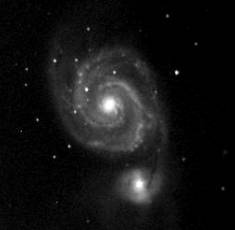
The very high speed of electromagnetic waves means that a
radar pulse only takes 2.5 seconds to travel to the Moon and back but the enormous
distance in the Universe means that light from a distant galaxy like the one shown in the
photograph still takes over thirty million years to reach us!
As we have already said
the properties of a particular radiation depends on where it is in the electromagnetic
spectrum, - this means on its wavelength and frequency. Gamma radiation has a very small
wavelength but a very high frequency while radio waves have a much lower frequency but a
far bigger wavelength.
Electromagnetic radiation is emitted a small packets of
energy called photons. These photons are emitted when electrons fall from one energy level
to another inside an atom.
(See: 14-16 Emission of light)