
Modulation is a way of sending signals of
low frequency over long distances without a huge loss of energy by the use of another wave
of very high frequency called a carrier wave.
High frequency signals are more
directional and because high frequency waves have a small wavelength there is less
diffraction. Also smaller aerials are needed because the size of the aerial has to be of the
same sort of size as the wavelength of the signal to be transmitted.
Therefore a
sound with a frequency of 256 Hz (middle C) received by a microphone, converted to an
electrical signal and then transmitted would have a wavelength of 300 000 000/256 = 1 170
000 m, over 1000 km!
However a wave of frequency 100 MHz has a wavelength of
only 3 m.
We can compare amplitude modulation with a long tube of soft clay on a
conveyor belt. The clay moves between the hands of two people, one at each end of the belt.
Modulation – the person at one end moulds the clay by pressing on it as it moves
between their hands. By squeezing and relaxing they make a tube of clay with a changing
diameter.
At the other end of the belt there is a person with their eyes shut and their
hands on either side of the clay at the other end. As the clay moves past their hands are
forced in and out by the changing diameter of the clay cylinder. This is called detection
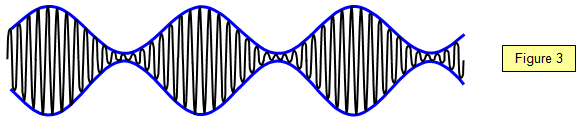
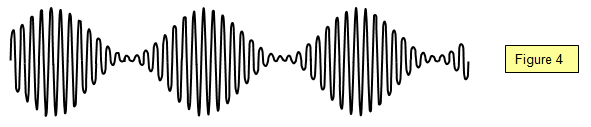
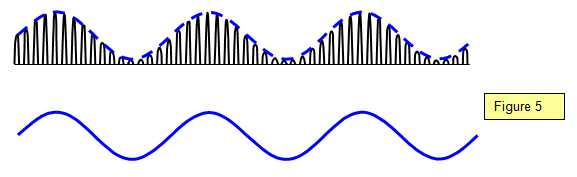
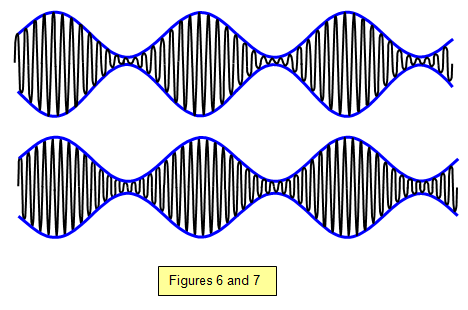
In reality we start with a carrier wave of very high frequency and add to it the audio
signal (of relatively low frequency). This addition of the audio signal is called modulation. This
can be done either by changing the amplitude of the carrier wave (amplitude modulation) or
by changing its frequency (frequency modulation).
The audio signal is produced
(Figure 1) and converted to an electrical signal by the microphone.