

The Earth is
surrounded by a thick atmosphere which provides us with the air we beathe, keeps the
planet warm and also protects us from harmful radiation from space. One of the most
important types of damaging radiation is ultra violet radiation from the Sun.
The part of
the atmosphere that filters out a lot of the ultra violet radiation is called the ozone layer – a
region of the atmosphere between about 15 and 40 km above the Earth's
surface.
The ultra violet radiation from the Sun is divided into three regions
depending on the wavelength of the radiation. These are known as UVA, UVB and UVC.
Some of the properties of these three types are decribed below.
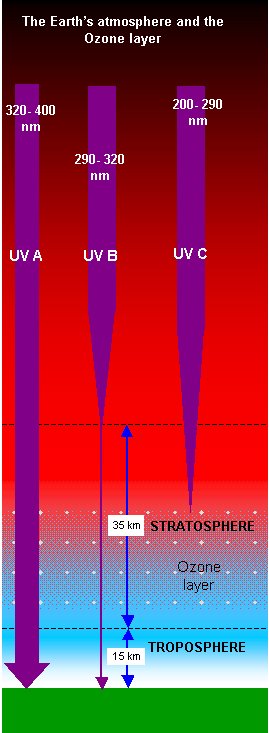
A reduction in the amount of
ozone in the ozone layer would allow more ultra violet radiation, especially UVC, to reach the
planet's surface and this increase would have a damaging effect on both plants and animals.
In the latter part of the twentieth century scientists discovered that the amount of ozone in the
ozone layer was being reduced by the emission of chemicals by industrial processes on
Earth. This effect was so severe that a hole appeared in the ozone layer above Antarctica.
Their studies showed that the ozone layer was being reduced in certain areas by
chlorofluorocarbons (CFCs) chiefly used in refrigerators, air conditioners, propellants in some
aerosol sprays and Styrofoam insulation. The damge to the ozone layer due to CFCs begins
when sunlight breaks down these molecules releasing atomic chlorine. Atomic chlorine
destroys the ozone which then increases the intensity of ultra violet radiation reaching the
Earth's surface.Other gases that can affect the ozone layer are CH2, nitrous oxide (N2O), and
sulphur dioxide (SO2).
However there are some optimistic results. In 2003 scientits
announced that the depletion of the ozone layer may be slowing down due to the
international ban on chlorofluorocarbons. Three satellites and three ground stations
confirmed that damage to the ozone layer has slowed down significantly during the past
decade. It is possible that further damage may still occur due to CFCs used by nations which
have not banned them, and by gases which are already in the stratosphere.
Finally
remember that damage to the ozone layer and the increase in sunburn has nothing to do
with global warming.