

The distance from the Earth of objects in the Solar System can be measured using radar. A pulse is sent out and the time taken for the reflected pulse to be received is recorded. Knowing the speed of electromagnetic radiation in free space and the time between transmission and reception the radar pulse enables us to find the distance of the object. For example the elapsed time would be 2.5 s for the Moon and up to 50 minutes for Jupiter and around five and a half hours for Pluto. (The last two numbers depend on the relative positions of the Earth, Jupiter and Pluto in their orbits)
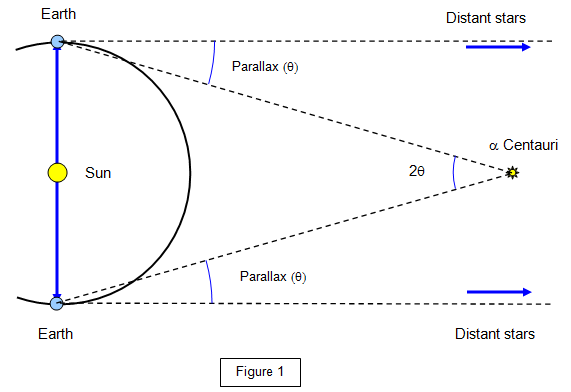
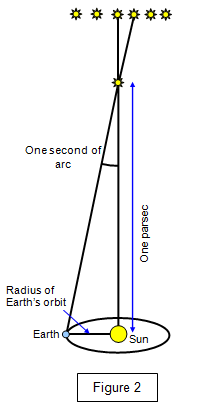
The difference in direction of a star viewed from the two ends of a line with a length equal to the radius of the
Earth's orbit is called the PARALLAX of the star.
Stars that are close to the earth
clearly have a larger parallax than ones far away. In other words their direction when viewed
from the Earth changes significantly as the Earth orbits the Sun.

| Star | Parallax (" of arc) |
Distance (light years) |
Star | Parallax (" of arc) |
Distance (light years) |
|
| Alpha Centauri | 0.750 | 4.3 | Vega | 0.133 | 25 | |
| Barnard's star | 0.545 | 6.0 | Arcturus | 0.097 | 34 | |
| Sirius | 0.377 | 8.6 | Aldebaran | 0.054 | 60 | |
| Procyon | 0.285 | 11.4 | Castor | 0.001 | 570 |
At distances much greater than this the parallax method
becomes impossibly difficult to measure. Remember that 1" of arc is the angle subtended by
a human head almost ¾ of a kilometer away. Therefore the parallax of Castor is the same as
the angle subtended by a human head at a distance of almost 750 km!
Another
method for measuring larger distances had to be found.
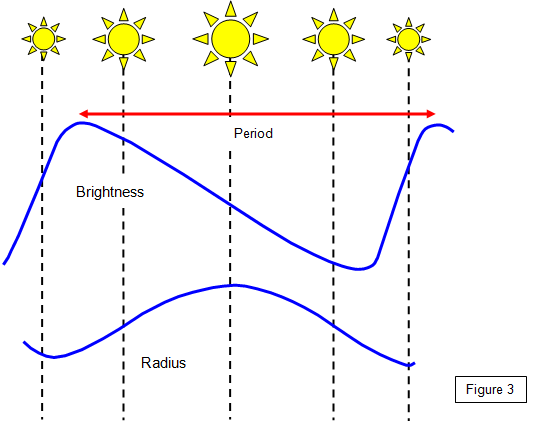
The brightness of the star varied in a
particular way (see Figure 3) and in 1912 Miss Henrietta Leavitt of Harvard College
observatory discovered an important connection between the period and brightness. This is
now known as the period-luminosity relationship. Many other stars were found to vary in a
similar way and the group of stars was called Cepheid variables. (There are actually two
types of Cepheid variable but we will just consider one type here).
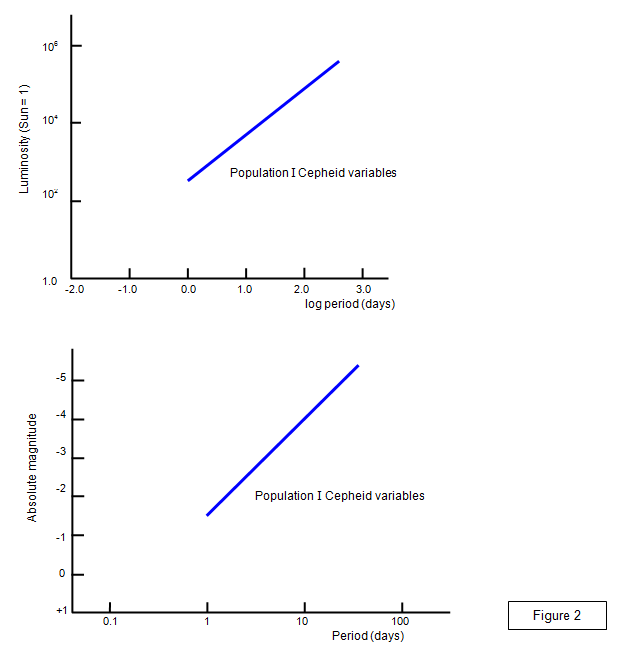
The period-
luminosity relation means that if you can measure the period of a Cepheid variable you can
find its luminosity. Knowing how bright the star really is and then measuring how bright it
appears to be will then give the distance of the star from the Earth. The discovery of Cepheid
variables in the Andromeda nebula (M31) enabled its distance from Earth (over two million
light years) to be found.
Two ways of presenting the period luminosity law
are shown by the graphs in Figure 4.
This relationship, named after the two American Astronomers who
discovered it, is not yet widely used because of lack of reliable data. It states that the more
luminous a galaxy the faster it rotates. Therefore measurement of the rotational speed of
galaxies using the Doppler effect gives a way of determining their distance from
us.
Astronomers therefore have to turn to the work of Edwin
Hubble.