

This experiment, first performed in
1887 by Michelson and Morley, was designed to establish the existence of the ether. The
ether was a massless fluid that was supposed to pervade all space and it was by a
disturbance of the ether that is was thought electromagnetic radiation travelled. Scientists
believed in the existence of the ether because they thought that all waves required a medium
through which to travel.
They reasoned that a beam of light moving parallel to the
Earth's direction of motion through the ether would take a different time to return to the
detector than one that moved at right angles to the Earth's motion.
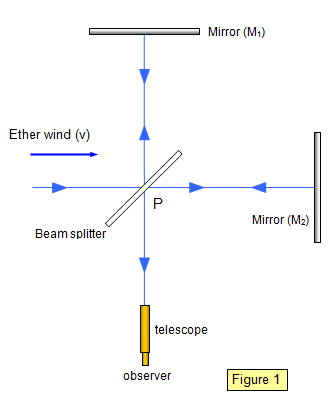
A simplified
diagram of their apparatus is shown in Figure 1. The measurements were made using an
optical interferometer where the interference fringes made by the two beams were observed.
It was capable of detecting differences in the speed of less than one tenth of the speed of the
Earth in its orbit round the Sun.
The Earth was considered to be moving from right to
left and the 'ether wind' was therefore flowing past it from left to right.
A beam of light was
emitted by the source S and split by the glass plate P. One beam then travelled along the
direction of motion of the Earth, reflected from mirror M2 and returned to the
observer. The other beam was bent through 90o so that it travelled at right angle to
the motion of the earth and was reflected by the mirror M1 before returning to the observe.
They actually used multiple reflections so that the path length was about eleven
metres.
If the velocity of the ether is v relative to the Earth then this must affect the
velocity of light relative to the Earth.
In the down wind direction the velocity of light
will be c + v, in the upwind direction c – v.
The time (t2) taken for the light to travel to the
beam splitter and back is:
t2 = d/[c+v] + d/[c – v] = 2d/c[1 –
d2/c2]-1
See the following diagram.

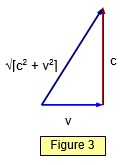 The time taken for it to return to
the observer would then be:
The time taken for it to return to
the observer would then be:The apparatus was rotated to check the
fringe shift for varying directions of the light beam.
However no matter in which
direction the apparatus was pointed no such shift in the interference fringes was observed
although the apparatus could detect movements as small as 0.01 of a fringe.
The
two times measured by the experiement were therefore equal and so the speed of light
seemed to be constant no matter in which direction the light beam was travelling relative to
the Earth's motion.
This result proved that the ether did not exist.
This null
result was to form a verification of the constancy of the speed of light, one of Einstein's
postulates in his Special Theory of Relativity proposed in 1905.