

Observation and analysis of the light coming from a star is the only way we have to determine the properties of the star. We can in fact find out a surprising amount of information about stars simply by the analysis of their spectra. A simple version of the type of stellar spectrum that you might observe is shown in Figure 1.
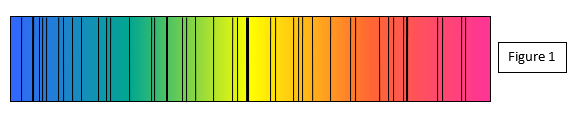
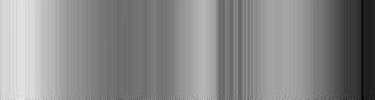
You can see that the spectrum is basically a continuous spectrum from violet to red but it is covered with many fine dark lines. These are absorption lines and in a real stellar spectrum there would be many hundreds of these spread across the whole spectrum. A black and white version of the spectrum of Sirius is shown below.
(a) the temperature of the star can be found by measuring the variation in intensity across the spectrum. M. When the wavelength of the peak intensity is found the temperature can be calculated using Wein's law.
(See also: Infra red and energy distribution)(b) by comparing the absorption lines due to a certain element with the emission lines of the same element produced in the laboratory the shift of the lines can be measure. Knowing the shift of the lines the velocity of recession can be found using the equations for the Doppler effect.
(See: Doppler effect)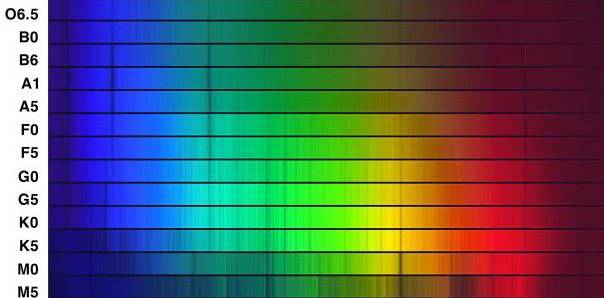
| Spectral class | Surface temperature (K) | Significant features |
| O | >20 000 | Helium ions |
| B | 10 000 - 20 000 | Atoms of helium and hydrogen |
| A | 7000 - 10 000 | Hydrogen atoms (Balmer series of spectral lines appear). Calcium, magnesium and silicon ions |
| F | 6000 - 7000 | Calcium ions. Iron and sodium atoms and ions |
| G | 5000 - 6000 | Calcium ions (Ca II) strong. Other metallic lines |
| K | 3500 - 5000 | Neutral metal atoms and some molecular bands appearing. |
| M | 2000 - 3500 | Molecular bands such as titanium oxide (TiO) and metal atoms. |
These broad classes of stars are divided into a more
detailed classification with each main section being split into at least ten subdivisions.
Therefore our Sun is a G type star but lies between the K and F types but nearer to the K
and is therefore known as type G2.
The next table gives some examples of stars of
different types.
| Star | Spectral class | Star | Spectral class | |
| Sirius | A1 | Capella | G6 | |
| Vega | A0 | Aldebaran | K5 | |
| Rigel | B8 | Arcturus | K1 | |
| Procyon | F5 | Betelguese | M2 |
Within each
spectral class some stars will be larger and therefore brighter than others. The larger stars
will generally have narrower spectral lines because of the reduced pressures in their outer
atmosphere. (See later in the section on the broadening of spectral lines)
These extra
classifications are shown below.