

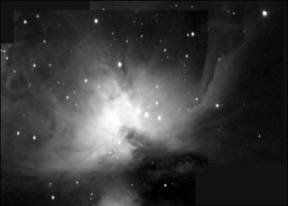
Stars form from the immense low-density gas clouds that lie in the Universe between the existing stars. The photograph shows one such cloud - part of M42 – the Orion nebula. A star the size of our Sun might form from a cloud that was initially a few tens of light years across and with a mass of about 2x1030 kg (that of our Sun) the density of these clouds is unimaginably small – about 5x10- 13 kgm-3.
As these clouds condense
under gravitational attraction the particles within it accelerate and collide with each other and
so their random kinetic energy increases. This means an increase in their thermal
energy.
The increase in thermal energy (E) of a particle whose kinetic energy
increases by ΔE is given by the equation:
ΔE =
3kΔT/2
where k is the Boltzmann
constant.
However from gravitational theory the gain in kinetic energy for a particle
'falling' from a radius R to a radius r is:
ΔE =
3kΔT/2 = GMm/r – GMm/R
but substituting values you will
find that GMm/R is very much smaller than GMm/r and so we can ignore it. This means that
the equation becomes:
3kΔT/2 = GMm/r and so DT/ = 2GMm/3kr
M is the mass of the whole cloud
(assumed spherical) and m is the mass of a proton on the outer edge of the
cloud.
Substituting the following values:
G = 6.67x10¹¹ Nm2kg-2,
M = 2x1030 kg, m = 1.7x10⁻²⁷ kg, r = 7x10⁸ m, k = 1.38x10⁻²³ JK-1
gives:
ΔT = 1.6x10⁷ – a sufficiently high
temperature for the onset of nuclear fusion under the conditions of high pressure within the
centre of the 'infant' star.