The discovery of the electron
The discovery of the electron and its properties were crucial stages in our understanding of the structure of the atom.
The following series of dates shows the way in which our knowledge of the electron developed.
1869 Hittorf developed and demonstrated the Maltese cross tube to show the effect of an electron gun.
(See:
Maltese cross tube)
1876 Goldstein first used the term ‘cathode rays’ for the radiation that appeared to come from the cathode of an electron gun.
He found that they 'cast a shadow' of a metal object placed in their path.
1879 Crookes deflected these rays with a magnetic field thus establishing that they were charged particles and not electromagnetic radiation.
This experiment also established the sign and direction of flow of the current carriers in the beam.
1897 J.J Thomson repeated the deflection of cathode rays using an electric field between two plates.
He also showed that the value of the charge to mass ratio (now called e/m) for the particles in the beam was always the same.
He also further demonstrated the Maltese cross tube and assumed that the charge carried was the same as that in electrolysis.
Hence he calculated the mass of the electron.
1909 Millikan measured the charge on the electron.
(See:
Millikan's oil drop experiment)
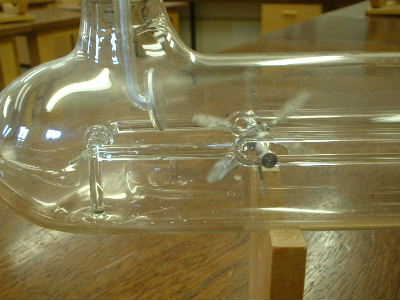
The photograph shows an 'electron paddle wheel'. The wheel runs along a glass track under the impact of an electron beam.
A VERSION IN WORD IS AVAILABLE ON THE SCHOOLPHYSICS USB