

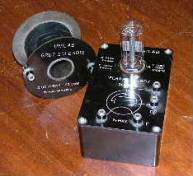
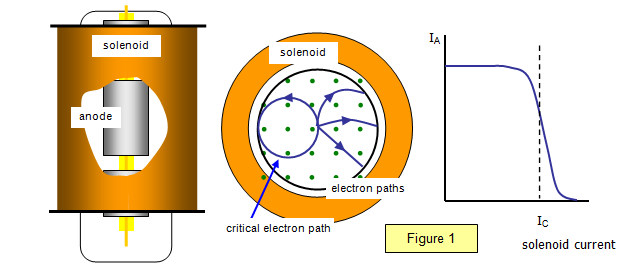
This is a valve with a cylindrical anode surrounding a linear cathode (Figure
1). This type of valve is very difficult to buy for schools now but provides a simple way to determine
e/m. A solenoid is placed over the valve with its axis coincident with that of the cathode.
With
no current in the coil of the solenoid the electrons emitted from the cathode travel in straight lines
along a radius and are collected by the anode - a current (IA) flows in the valve. Now if a current is
passed through the solenoid a magnetic field will be produced and the emitted electrons will begin
to curve in the field - the radii of their paths becoming smaller and smaller as the current, and
therefore the magnetic field is increased. Up to this point the anode current remains constant.
Eventually a point will be reached for a solenoid current IC where the diameter of their
path is just equal to the radius of the anode, any further increase in the solenoid current and the
electrons will not hit the anode. There will then be a sudden drop in the anode current.
In the magnetron we must assume that the cathode is very narrow, so that the electric field at its surface is high. If we do this then we can also assume that the electrons experience most of their acceleration close to the cathode and so their velocity across the rest of the valve to the anode is uniform.