Resistance and temperature
When a material is heated its resistance will
change. This is due to the thermal motion of the atoms within the specimen
The
equation for this variation is:
Rθ = Ro[1+ αθ + βθ2 + ...]
where R
θ is
the resistance of the specimen at some temperature θ
oC and R
o the resistance
at 0
oC. In this equation β is much less than α and so we can
express the change by the following simplified equation as long as the temperature
change is not too great.
Rθ = Ro[1+ αθ]
Here α is called the temperature coefficient of
resistance and is defined as the increase in resistance per degree rise divided by the
resistance at 0
oC
α = [Rθ - Ro]Roθ
Some
values of the temperature coefficient of resistance (α)are shown in the following table:
| Material |
ax10-4K-1 |
|
Material |
ax10-4K-1 |
| Copper |
43 |
|
Tungsten |
60 |
| Carbon |
-5.1 |
|
Nichrome |
0.88 |
| Gold |
36 |
|
Steel |
33 |
For a metal the temperature
coefficient of resistance is positive - in other words and increase in the temperature gives
an increase in resistance. This can be explained by the motion of the atoms and free
electrons within the solid. At low temperatures the thermal vibration is small and electrons
can move easily within the lattice but at high temperatures the motion increases giving a
much greater chance of collisions between the conduction electrons and the lattice and so
impeding their motion.
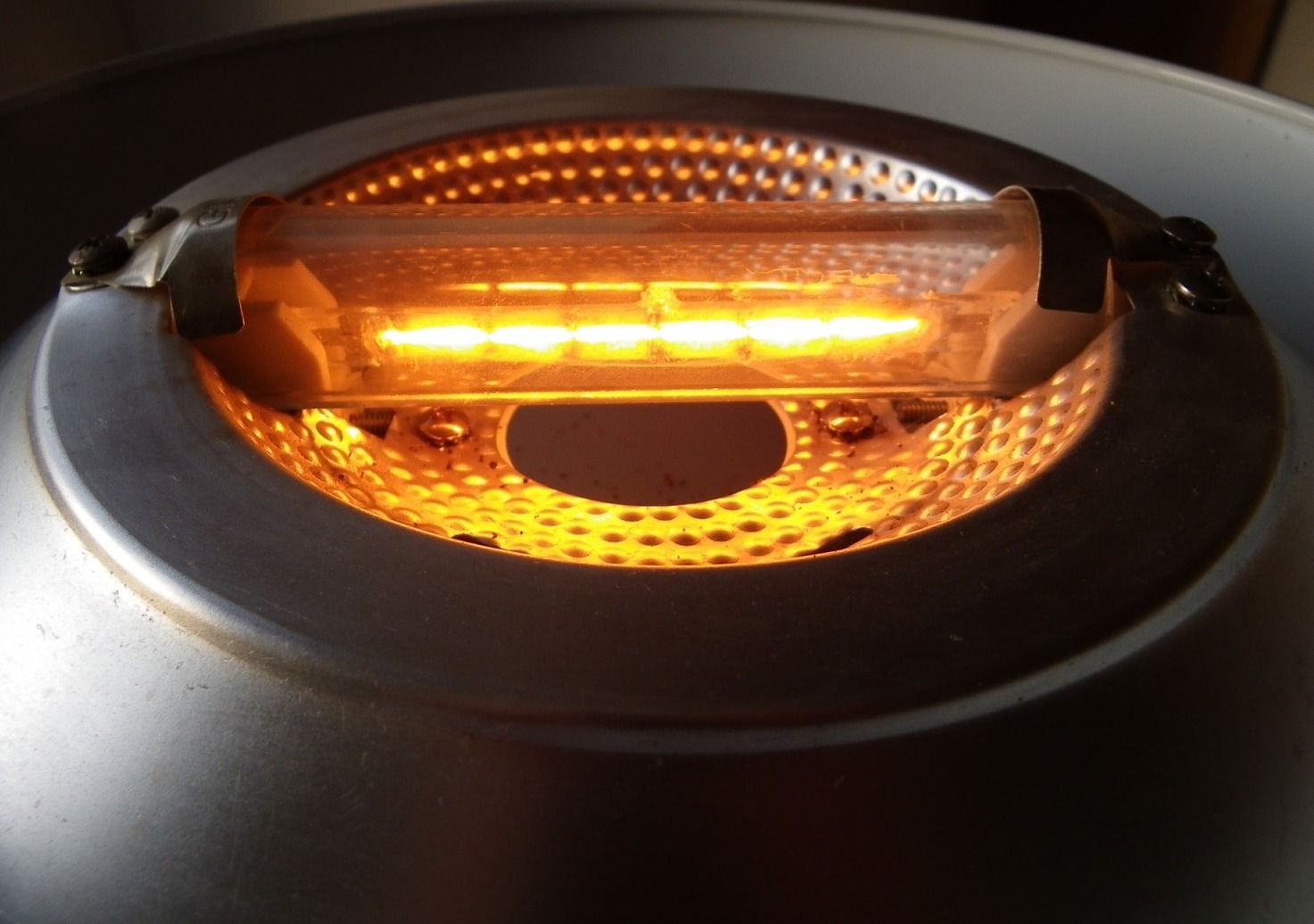
In a light bulb the filament is at about 2700 oC when it is
working and its resistance when hot is about ten times that when cold. (For a typical
domestic light bulb the resistance measured at room temperature was 32Ω and this rose to 324Ω at its working
temperature).
Example problem
If the resistance of a length of copper wire is 4.5 W at 20 oC calculate its resistance at 60 oC.
Using : Rq = Ro[1+ aq ] we have
4.5 = Ro[1+ 43x10-4 x 20] therefore
Ro = 4.5/1.086 = 4.14 W and so
R60 = 4.14[1+ 43x10-4 x 60] = 4.14x1.258 = 5.21 W
We can also
define the change in the resistivity with temperature by an equation similar to that for
resistance:
ρθ = ρo[1+ βθ]
where β is the temperature coefficient of resistivity.
We require that the variation of resistance should be small so β should be as
small as possible for thermal stability.
The following table gives the temperature
coefficients of resistivity for a number of materials:
| Material |
|
βx104K |
|
Material |
|
βx104K |
| Copper |
|
43 |
|
Aluminium |
|
38 |
| Lead |
|
43 |
|
Nichrome |
|
1.7 |
| Eureka |
|
0.2 |
|
Manganin |
|
0.2 |
| Iron |
|
62 |
|
Platinum |
|
38 |
| Carbon |
|
-0.5 |
|
Tungsten |
|
60 |
However in non-metals such as semiconductors an increase in temperature leads to
a drop in resistance. This can be explained by electrons gaining energy and moving into
the conduction band - in fact changing from being bound to a particular atom to being able
to move freely - an increase in the number of free electrons. The temperature coefficient
of resistance and also that of the temperature coefficient of resistivity is therefore
negative.
Problems
Where necessary use the values for the temperature coefficient of resistance quoted in the preceding tables.
1. Calculate the change in the resistance of a gold wire if the temperature rises from 293 K to 315 K if its resistance at 293 K was 2.5 W.
2. A tungsten filament has a resistance of 20 W at 20 oC. What is its resistance at 1500 oC
3. A tungsten filament lamp has a filament whose resistance increases from 30 W at 20 oC to 350 W at its operating temperature. Calculate the operating temperature of the lamp.
4. A coil of wire has a resistance of 3.5 W at room temperature (18 oC) which rises to 6.5 W when placed in boiling water. Calculate the temperature coefficient of resistance of the metal of the coil.
5. A semiconductor used as a thermometer has a resistance of 2 kW at 15 oC and this falls to 25 W at 100 oC. Calculate the mean temperature coefficient for the material over that range.
(See
also superconductivity)
A VERSION IN WORD IS AVAILABLE ON THE SCHOOLPHYSICS USB