

The direction of the induced e.m.f. was explained by Lenz who proposed the following law in 1835:
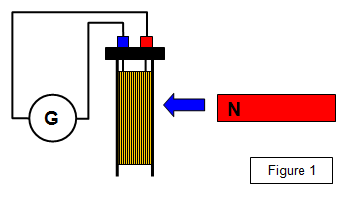
We can explain this law by considering the energy changes that
occur when a magnet is moved towards a coil, as shown in Figure 1. Assume that the magnet is moved towards the coil with its north pole facing towards the coil. Now by Lenz's law
this should induce a current in the coil such that the right-hand end of the coil (B) nearest the
magnet is also a north pole. If this is true then it should repel the magnet and work must be
done on the magnet to move it in against this repulsion.
The energy used goes
to produce the induced e.m.f. in the coil.
This would agree with Lenz's
law.
However, if we assume that the e.m.f produced is in the opposite sense and
gives a south pole at B then as the magnet is moved in it will experience an attraction due to
the e.m.f. in the coil. This will accelerate it, the e.m.f. produced will increase in size, the
acceleration will increase and so on.
Clearly energy is being produced from nothing
and this is impossible.
