Mutual inductance
When the current in a coil is changing an e.m.f will be induced
in a nearby circuit due to some of the magnetic flux produced by the first circuit linking the second.
The phenomenon is known as mutual induction. It is important to realise that the induced e.m.f. lasts
only as long as the current in the first circuit is changing.
The mutual inductance M is defined by
the equation
Mutual inductance (M) = -E/[dI/dt]
where E is the e.m.f induced in
the secondary coil and dI/dt the rate of change of current in the primary.
Two coils are said to
have a mutual inductance of 1 H if an e.m.f. of 1 V is induced in the secondary when the current in the
primary changes at the rate of 1 A s-1.
Induction coils such as this are used in car ignition circuits,
and used to be a source of high voltage for research.
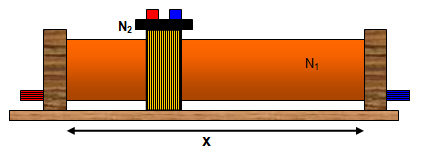
Consider the mutual inductance of a long solenoid and a coil as
shown in the diagram.
Suppose that a short coil of N
2 turns is wound round a
solenoid of N
1 turns, with a cross-sectional area A, length x and carrying a current I.
The flux at the centre of the solenoid is: B = μ
oN
1I/x
The flux linking the short coil is φ = BA and therefore the flux linkage of the short coil
is
N2φ =BAN2= [μoN1I/x]AN2
If the current in the primary changes by dI in time dt, giving a change in flux linkage of d(Nφ) in the secondary, then the e.m.f. induced in the secondary will be
E =
d(Nφ)/dt = [μoN1/x]AN2 dI/dt
Writing M as the mutual inductance, we have that E = - MdI/dt and therefore
Mutual inductance (M) = [μoAN1N2]/x
Example problem
Calculate the mutual inductance of a pair of coils if the primary has 1000 turns of radius 2 cm and is 1 m long while the secondary has 1200 turns and is wound round the centre of the primary.
M = 4πx10-7x4x10-4x1000x1200
= 1.90x10⁻³ H = 1.90 mH
A VERSION IN WORD IS AVAILABLE ON THE SCHOOLPHYSICS USB