The action of a dielectric
When a dielectric material is placed between
the plates of a parallel-plate (or other) capacitor the capacitance increases. The reason for
this is shown in Figures 1(a) and 1(b).
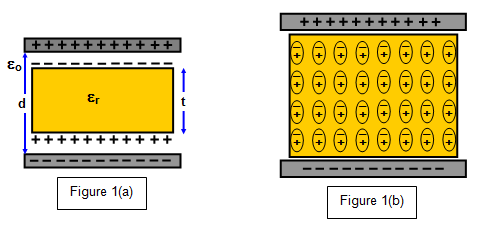
The charges on the plates of the capacitor induce opposite
charges on the two surfaces of the dielectric. This has the effect of reducing the potential
difference across the capacitor.
This can be explained as follows. Under the
action of the electric field within the dielectric the molecules become polarised and are
aligned as shown in Figure 1(b).
Since the capacitance of a capacitor is given by the
formula C = Q/V, if the p.d. (V) across the capacitor is reduced the capacitance must be
increased.
The capacitance of a parallel-plate capacitor with a material of relative
permittivity εr filling the space between the plates is
Capacitance (C) = εoεrA/d
where ε
r is the
ratio of the capacitances when the space between the plates is a vacuum or a
dielectric.
The capacitance of a capacitor when only a thickness t of the air space is
filled is
Capacitance (C) = εoεrA/[εr(d-t) + 1]
The following example
should illustrate how to deal with some of the problems of dielectrics and
capacitors.
Example problem
A parallel-plate capacitor has an area of 100 cm
2, a plate separation of 1.0 cm and is charged initially to a potential of 100 V (call this V
o).
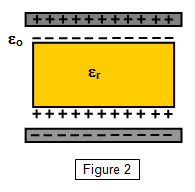
The supply is disconnected and a slab of dielectric, 0.5 cm thick and of relative permittivity 7, is then placed between the plates as shown in Figure 2.
Calculate:
(a) the capacitance C
o before the slab is inserted
(b) the charge on the plates Q
(c) the electric field strength in the gap between the plates and the dielectric
(d) the electric field strength within the dielectric
(e) the potential difference between the plates after the dielectric is inserted
(f) the capacitance when the dielectric has been inserted.
(a) C = ε
oA/d = [8.9x
-12x10
-2]/10
-2= 8.9x10
-12 F.
(b) Q = C
oV
o = [8.9x
-12 x 100] = 8.9x10
-10 C.
(c) Eo = Q/ε
oA = 8.9x10
-10/[8.9x10
-12x10
-2] = 10
4 Vm-1
(d) E1 = Q/εA = E
o/ε
r = 10
4/7 = 0.14x10
4 Vm
-1
(e) p.d. = [0.5x10
4 + 0.5x0.14x10
4]/100 = 57 V
(f) C = εA/[ε
r(d – t) + t] = 7ε
oA/0.04 = 15.2x10
-12 F.
WORD VERSION AVAILABLE ON THE SCHOOLPHYSICS CD