

Charge distribution over a
surface.
1. We must assume that the potential is equal over the surface. This will be true
when equilibrium is reached – a very short time after the conducting solid has been
charged.
2. Let the charge density of a surface be denoted by σ
3. The potential at a
distance r from a sphere carrying a charge Q is given by:
Potential (V) =
[1/4πεo]Q/r
4. Charge density of the sphere (s) = Q/4πr2
5. Potential (V) =
[1/4πεo]σ4πr2/r = [1/εo]σr and so
Charge density (σ) = Vεo/r
6. Therefore the charge
density at a point on the surface of radius r is inversely proportional to r. In other words a
small r (a sharply curved surface) has a greater charge density than a surface with large R.
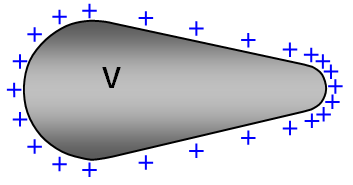
Think of two spheres of different radii
charged to the same potential. If they are joined together by a wire no charge will flow
between them (same potential) but the charge density on each will be different. Now instead
of a wire fit a charged conducting surface (same potential as the spheres) between them to
form the shape shown in the following figure. Again there will be no charge flow and the
charge distribution will therefore be different at different points on the surface.