Experimental work in Physics
Since the very basis of much of the
study of Physics is by experiment it is important to know how to carry experiments properly
and how to present your results in the correct way. Very little faith can be put in a theory if it
can never be backed up by an experiment. They are of two main types:-
(a) standard
investigations that are designed to prove accepted quantities or laws
(b) "open ended"
experiments which are designed to investigate previously "unknown" areas of the subject
where there may be no previously recorded answers
Possible open ended
experimental investigations
| 1. Energy in a balloon |
20. Drag on small boats – use a piece of guttering |
39. Friction in curtain rails |
| 2. Viscosity of liquids |
21. Extension of the wire experiment – surface area/bolometer |
40. Cars and carpet – braking experiments |
| 3. How bubbles arise in liquids |
22. The properties of a small water pump |
41. The strength of adhesives |
| 4. Forces in athletics |
23. Electromagnetic induction – separated coils – thickness measurement |
42. Bouncing balls |
| 5. Vibrations in a soap film |
24. Energy in a light bulb – LDR etc. – colour effects |
43. Optical properties of treacle |
| 6. Defects of a lens - astigmatism |
25. Mixing water and methanol |
44. Stretching a rubber band – heat effects |
| 7. The propeller and drag |
26. Expansion of a loaded rubber band when it is heated |
45. Strength of plants – bending in the wind |
| 8. Mechanical resonance |
27. Resonance in buildings – earthquake simulations |
46. The bifilar suspension |
| 9. Growth of current in a light bulb |
28. Absorption of light by glass |
47. Waves on a stretched spring |
| 10. Diffraction and resolution |
29. Potential on a Van der Graaff – paper levitation |
48. Falling magnet |
| 11. Singing tube |
30. Attractive forces in electromagnets |
49. Fatigue in aluminium strips |
| 12. Craters |
31. Resonance in buildings – earthquake simulations |
50. The bifilar suspension |
| 13. Damping and resonance |
32. Reflection of microwaves from mesh of different sizes |
51. Effect of polish on friction |
| 14. Strength of a polythene bag |
33. Transmission of light through glass and water |
52. The silt meter |
| 15. Conductivity of salt solution |
34. Thrust of model aircraft propellers |
53. Transformer efficiency |
| 16. Capillarity in sugar cubes |
35. Electromagnetic clutch |
54. Strengths of wet and dry tissues |
| 17. Bending of a beam |
36. Photochromic sunglasses |
55. Penetration of nails into wood |
| 18. The jumping ring |
37. Standing waves on a vibrating wire hoop |
56. Objects in an air stream |
| 19. Viscosity of liquids |
38. Vibrations in a soap film |
|
Some further comments on "open ended" experiments
In these experiments you cannot be
sure what you will find - you won't find them written up in any book so it is especially necessary that
you plan them carefully.
Before starting ask yourself these questions and be able to answer
them!
What am I going to measure or investigate?
Do I need a control experiment?
What apparatus will I need and is it available?
Are my aims realistic?
How much time will I need for the investigation?
What is my overall plan of action?
Will the readings be taken manually or automatically?
How will I present my results?
Are there any safety considerations that I should think about?
Suggested procedure for
practical work
You should treat all your experiments carefully, no matter how simple they
appear to be. Although it is unlikely that you will stumble on a new law of physics during your a level
course there is always a chance and careful experimental work just opens up that possibility! A good
experimental technique gained at this stage could be of immense use later on.
When
embarking on an experiment try and follow something close to the following suggestions:
1.
Read all the instructions carefully before starting your practical work
2. Check that you have
all the apparatus that you need and that you know how to use it. This is especially true of meters and
power supplies - ask for help if you are not sure which output or range to use before switching
on.
3. Plan your work before doing anything, that includes the setting up of the apparatus
and the presentation of results
4. Decide on the both the spread and the number of readings
that you are going to take of the various quantities.
5. Do not "set" your values to exact
numbers - i.e. when making a series of measurements of the period of swing of a pendulum take
readings at roughly 5 cm intervals - do not try to adjust the length to exact multiples, it will be very
difficult and you are likely to measure inaccurately
6. Always repeat your readings if there is
time and certainly check any reading that is to become a "base" value used in many later parts of the
experiment. Do not rush your work!
7. All results should be quoted to a sensible degree of
accuracy and this accuracy recorded. Don't claim an unreasonable degree of accuracy. Although a
stop clock may show times to within 0.01 s you may only be able to judge when to press it to +/- 0.1 s
and it this that should be quoted as an accuracy.
8. If you are asked for the gradient of a line
in a practical question it is likely that the line is a straight one, but if the slope at a specified point is
asked for then the line will probably be a curve.
9. Include a comment of all errors and
difficulties and how you overcame them or suggestions for their solution.
10. A full and
complete conclusion should appear at the end of each experimental account. Remember that
experiments without a mathematical answer are just as important as those that do have a numerical
result and a conclusion is still
needed.
Tables of
results
When writing up your practical work it is essential that tables of results are
presented properly. They should:
Be fully ruled out using a ruler
Contain the correct
information at the top of each column
Contain only figures in the actual measurement and
calculation section
Contain the quantity at the top of each column
Contain the correct units at
the top of each column
Contain an estimate of the accuracy of measured quantities at the top of
each column
An example of part of such a table is set out below:

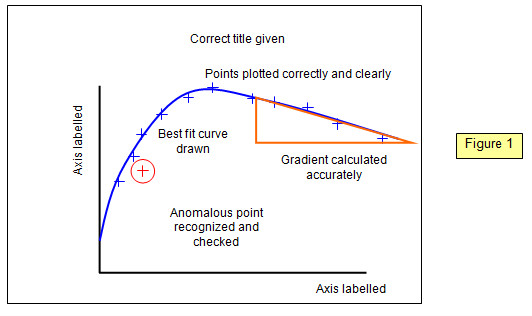
Drawing a graph
When drawing graphs
the following points should be remembered:
1. The graph should fill the page if possible
2. It
should have a sensible scale (e.g. 5 units matching five squares etc.)
3. The scale should be labelled with
the quantity, symbol and units
4. The points should be clearly plotted, either as a small cross or a dot with a
circle round it
5. The graph should be given a title
6. The line should always be the best fit curve
(maybe a straight line) unless you are specifically requested otherwise.
7. At least eight points should be
plotted for a straight line graph and ten for curve
8. The gradient should be taken over as large a section of
the graph as possible
A VERSION IN WORD IS AVAILABLE ON THE SCHOOLPHYSICS USB