

If an object is being swung round on a string in a vertical circle at a constant speed the centripetal force must be constant but because its weight (mg) provides part of the centripetal force as it goes round the tension in the string will vary. (See Figure 1)
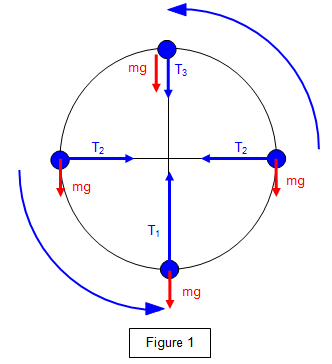
Let the tension in the string
be T1 at the bottom of the circle, T2 at the sides and T3 at the
top.
At the bottom of the circle :
T1 - mg = mv2/r so
T1 = mv2/r + mg
At the sides of the circle:
T2 =
mv2/r
At the top of the circle:
T3+ mg = mv2/r so
T3 = mv2/r - mg
So, as the object goes round the circle
the tension in the string varies being greatest at the bottom of the circle and least at the top.
Therefore if the string is to break it will be at the bottom of the path where it has to not only support
the object but also pull it up out of it straight-line path.
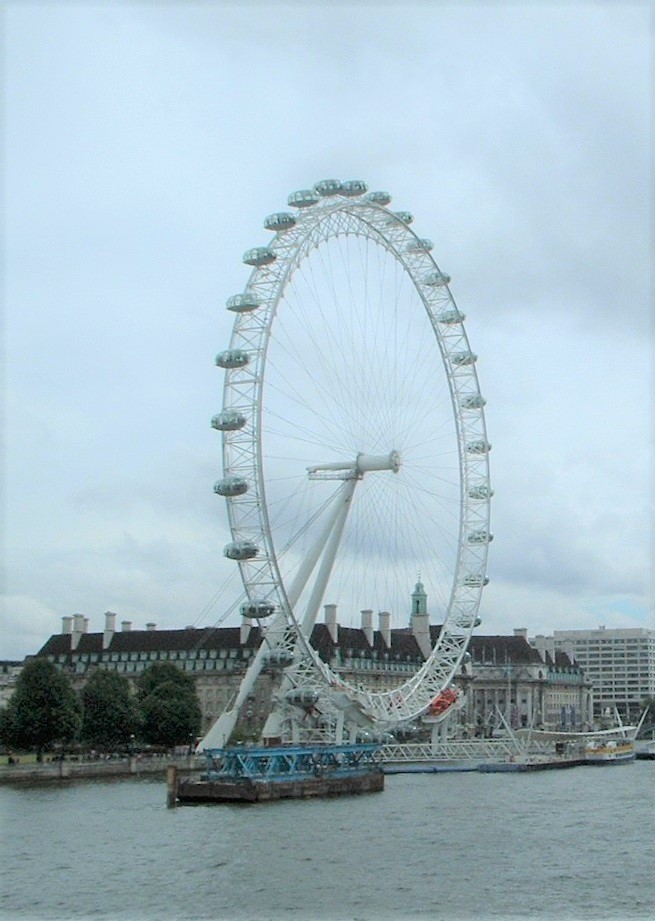
An example of this would be an
aircraft looping the loop or some of the funfair rides already mentioned. The g force on the pilot
would be greatest as they try and pull out of the bottom of the loop, and this is the place they
would expect to black out if they are travelling round the loop at constant speed.