

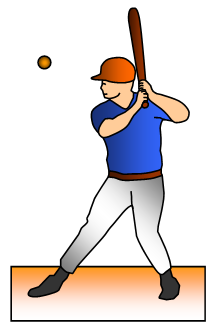
When you catch a ball of mass
m that was travelling at velocity v the change of momentum of the ball during the catching is mv.
To do this you must apply a force F for a time t. So since impulse equals change of momentum Ft
= mv. You can see that the longer you take to bring the ball to rest the smaller the force - that's
why it is sensible to "bring your hands back" when catching a ball - especially a hard one like a
cricket ball, the ball does not "give" so you must.
When you hit the ball straight
back the change of momentum is much bigger.
Momentum of ball before collision =
mv
Momentum of ball after collision = - mv [momentum is a vector and we must allow for the
change of direction, the minus sign tells you that the ball is moving in the opposite direction].
Therefore change of momentum of ball = mv - (-mv) = 2mv
So force on the ball
F = 2mv/t and if the time spent in hitting the ball backwards is the same as that spent in catching
you can see that the force will be twice as large.