

Coal
Oil
Gas
Since there is a limit to
the reserves of fossil fuels considerable work is being done to develop other alternative
sources of energy.
The major need of the western world is to use one of the primary
sources of energy to generate electricity. Some of the various primary sources are
considered below.
Alcohol can be produced from cane sugar, maize, cassava, sago palms, yams and other root crops and then used to generate heat and finally electricity. The growth of some bacteria may also be a way of producing flammable gases.

This results from
the flow of heat up through the Earth's crust from hotter rocks beneath the surface. In Iceland
30 per cent of domestic hot water is produced using geothermal energy. In Britain the
average thermal gradient appears to be about 40 oC km-1 and the average potential for heat
extraction is some 6 x 10⁻² W m-2
The maximum value found globally
is some 10W m-2.
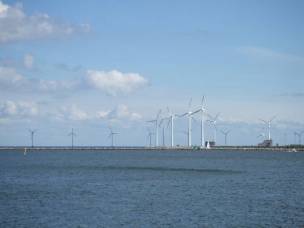
Hydroelectricity now generates some 20-25 per cent of the world's electricity and there are about 100 schemes of 100 MW capacity throughout the world. The pumped storage system as used in Snowdonia is a useful variation of the normal hydroelectric power.
The tidal barrage across the river Severn is still
being considered as a potential large energy source. This scheme, which would be the
biggest of its kind in the world would use 192 turbines with an installed capacity of over 7000
MW. A smaller scheme for the River Mersey would have a capacity of some
500MW.
There would be major environmental impact from such a large dam so submersible turbines have been considered. The problem with these is that the water flow through them needs to be laminar. In the case of the turbulent waters of the Severn estuary it is likely that the turbine blades would break apart due to instability.
The heat from the Sun may be used to produce steam, and this steam used to drive turbines. One array of mirrors in Southern California has an area of 7.3 x 10⁴ m2 and the steam produced by it gives an electrical output of 10 MW. This facility assumes 300 cloudless days a year! An alternative form of solar power is to convert the sunlight to electricity directly using photovoltaic cells. Cost is a problem here (at the time of writing it is some $0.7 per watt) but this method may still be attractive in very sunny positions.
The use of nuclear
fission for the generation of electricity has become very important in this century. Many
countries in the world such as the USA, Great Britain, France, Canada and the Soviet Union
have a well-developed nuclear fission reactor programme although the reactors are of
different types. The nuclear fusion reaction may be a source of energy in the future although
this may not be until after the year 2020.
The large requirement of energy means
that these alternative energy facilities have to be large if they are to replace conventional
plant to any substantial extent. For example, to generate the 1000 MW produced by many
large power stations would need one of the following:
300 windmills each with a 100
m diameter rotor
a large tidal barrage
a very large dam in a hydroelectric
scheme
a 400 km2 solar collector
a 100 km ocean wave-powered
generator.
It is hoped to use the osmotic pressure the could be produced in estauries to give usable energy. osmotic power is a clean, renewable energy with a global capacity of some 1600 TWh - equal to the annual consumption of China.
Almost everything that happens in the world is a result of a change of energy from one form to another, although the conversion is never 100 per cent efficient. The following table shows the amounts of power used by an adult male of mass 76 kg when doing various activities.
| Activity | Power used (W) | Activity | Power used (W) | |
| Sleeping | 83 | Swimming (breaststoke 1.6 km hr-1) | 475 | |
| Sitting | 120 | Skating | 535 | |
| Riding in a car | 140 | Climbing stairs (116 steps min-1) | 685 | |
| Walking (4.8 kmh-1) | 265 | Tennis | 440 | |
| Cycling (15 kmh-1) | 410 | Cycling (21.3 kmh-1) | 700 | |
| Basketball | 800 | Running (100 m at 36 kmh-1) | 1500 |