Gravitational Potential energy
A body has energy if it is capable of
doing work. In this case it is the position of the body in a gravitational field that gives it this
possibility.
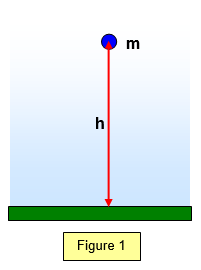
The energy associated with the position of a body of mass m in a gravitational field is the gravitational potential energy of the body compared with some chosen reference point where h = 0, usually the surface of the Earth. (Figure 1)
Gravitational potential energy (GPE) = mgh
where g is the intensity of the gravitational field (assumed uniform
here) and h is the vertical distance moved in the field.
The energy is
converted to other forms when the gravitational potential energy changes due to a movement
within the field. (Figure 2) If the distance moved parallel to the gravitational field is Dh then the change in potential energy is:
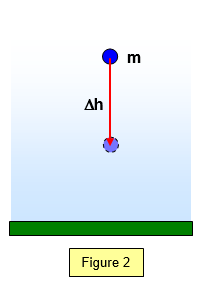
Gravitational potential energy change = mgDh
It
is important to realise that D h is measured parallel to the field.
Any other direction of movement will cause a smaller change in the gravitational potential
energy and a body that moves at right angles to the field will have no change at all in their
gravitational potential energy.
Example problems
1. A crane lifts a load of 300 kg through a distance of 2.5 m onto a truck. Calculate the gain in gravitational potential energy. Gravitational field intensity = 9.8 Nkg-1.
Gravitational potential energy gained = mgDh = 300x9.8x2.5 = 7350 J
2. A mass of 25 kg is moved a distance of 35 m at an angle of 20o to a gravitational field of intensity 9.8 Nkg-1. Calculate the change in gravitational energy.
Change in gravitational potential energy = 25x9.8x35cos 20 = 8057 J
A VERSION IN WORD IS AVAILABLE ON THE SCHOOLPHYSICS USB