
 You can
appreciate that if you are hit by a fast moving stream of water from a hose pipe you experience a
force - if this hosepipe is a water cannon then the force could be great enough to knock you over.
You can
appreciate that if you are hit by a fast moving stream of water from a hose pipe you experience a
force - if this hosepipe is a water cannon then the force could be great enough to knock you over.
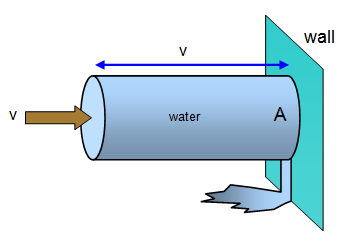
Consider a hosepipe of cross
sectional area A that gives a jet of water of velocity v. If this hits a vertical wall and loses all
its momentum then in one second a jet of length v will hit the wall and so:
Mass of
water striking the wall per second = rvA where r is the density of the water
Force
on wall = rate of change of momentum of water = change of momentum per second = [rvA]v = rv2A
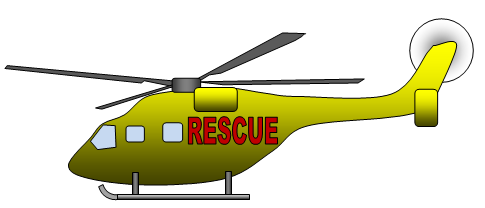
Imagine a helicopter
hovering above the ground. The blades on the rotor are angled slightly so that as they spin
round they thrust a column of air downwards - it is this column of air moving vertically that
keeps the helicopter up. The faster the blades rotate and the larger they are the bigger the
lift, so large helicopters need large blades or even two rotors.
Now as before for the
water jet force = rate of change of momentum and so for the helicopter to hover the
momentum change per second of the air column must be equal to the weight of the
helicopter.
Remember that Power =
Force x Velocity however in this case the velocity of the air column is being increased from
zero to v and so the average velocity is v/2. This gives the power as:
Power = Force x
average velocity = rpr2v2 x v/2 = rpr2v3
Some examples of powers: Lynx
helicopter power range 670 kW - 835 kW Power boat = 112 kW