

In many tall modern buildings there are high-speed lifts moving between the floors. It is therefore useful to look at how we feel as the lift goes up and down. Your mass will always stay the same - remember that mass has to do with your inertia and that does not alter. Your weight - the gravitational pull of the Earth also stays the same no matter what the lift does but the reaction between your feet and the floor of the lift may change depending on the way the lift moves.
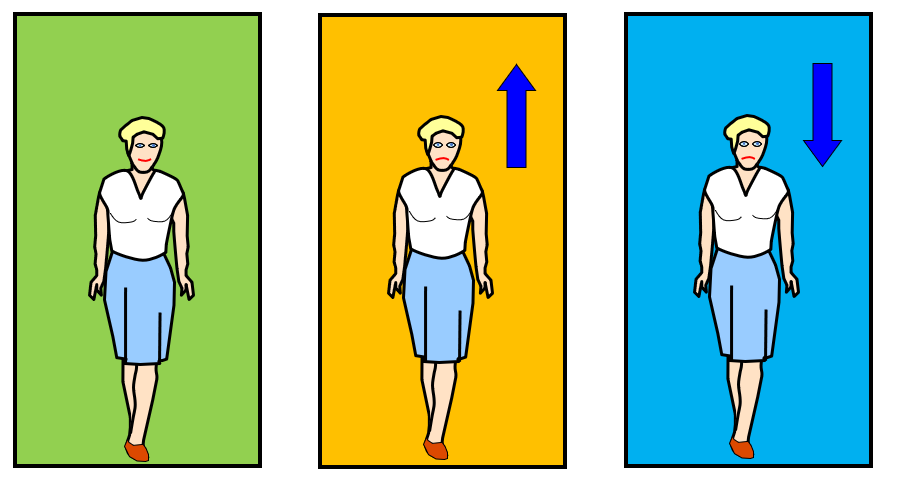
If the lift is stationary or moving up or down at a steady speed then the reaction stays the same - there is only a change when the lift accelerates - accelerating a mass means an unbalanced force must be acting. If it accelerates upwards the floor of the lift has to apply a force not only to hold you up but also to accelerate you - the reaction increases. If the lift accelerates downwards the reaction at the floor is less, and if someone cuts the rope the reaction is zero, you are in free fall until you reach the ground!

For
example think about a girl of mass M and weight W standing on the floor of a stationary lift.
Consider what will happen to the reaction R between her feet and floor as the lift
moves in the following ways?
(a) moves upwards at constant velocity
(b) moves
downwards at constant velocity
(c) accelerates upwards at constant acceleration
(d)
moves downwards at constant acceleration
(e) someone cuts the supporting rope and
the lift falls!
(a) W = W and R = Ro = W - no acceleration therefore no change in
reaction
(b) W = W and R = Ro = W - no acceleration therefore no change in
reaction
(c) W = W and R > Ro - acceleration upwards
(d) W = W and R < Ro -
acceleration downwards
(e) W = W and R = 0