

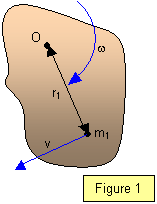
 Rotating bodies show the same reluctance to a change in their
angular velocity as bodies moving in a straight line do to a change in their linear velocity.
This is due to a property of the object known as its angular momentum. A body can possess
angular momentum as you can see from Figure 1.
Rotating bodies show the same reluctance to a change in their
angular velocity as bodies moving in a straight line do to a change in their linear velocity.
This is due to a property of the object known as its angular momentum. A body can possess
angular momentum as you can see from Figure 1.The units for angular momentum are kg
m2 radian s-1
You should have expected a result like this, as it
is similar to that for linear momentum (mu). (I taking the place of m and ω taking the place of u)
In the same way that if a force is
applied to a body for a certain time it will change the linear momentum of a body the
application of a couple C for a certain time t will change the angular velocity from ωo to ω1 and so give a change of angular
momentum of the body such that:
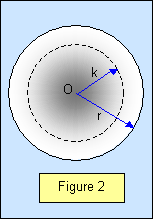
A useful term when considering
rotating objects is one known as the radius of gyration. We can write the moment of inertia I
of a body as Mk21 where M is the mass of the body and k is a distance
called the radius of gyration of the body. For example, for a disc the moment of inertia is
Mr2/2, and so k = (r2/2)1/2 = r/21/2 .
(see
Figure 2).
The radius of gyration can be defined as the distance from the centre of
rotation of a rotating body to the point where the mass can be considered to be concentrated
(not to be confused with the centre of mass).
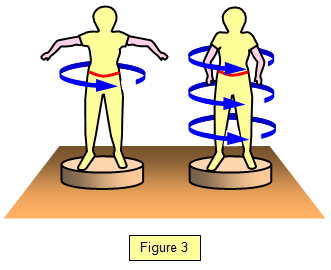
A very simple demonstration of this law can be shown by a person standing on a rotating
platform. If they first rotate with their arms outstretched and then bring their arms in, their
angular velocity will increase. (Figure 3).
This happens because their angular
momentum must remain constant, the decrease in their moment of inertia as they drop their
arms results in an increase in their angular velocity. The effects are much more impressive if
the person holds a heavy book or a 1 kg mass in each
hand.
Many of you will have experienced the effects of the
conservation of angular momentum when riding a bike. It is very hard to keep the bike
upright when it is stationary, but as soon as the bike is moving and its wheels are rotating it
becomes much easier.
The rotation of the wheels produces angular momentum and prevents
the bike from falling sideways, because this would give a change in the angular momentum
(since this is a vector quantity).
A helicopter is prevented from rotating about a vertical axis either by the small tail rotor or by a sideways jet of air ducted through the tail
boom.