

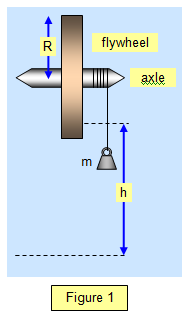
A flywheel of radius R is set up on a horizontal axle of radius
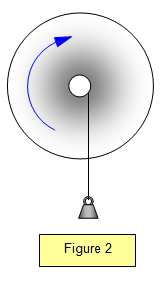
r. A string of length h is wrapped round the axle with a mass m tied to the end (Figures 1 and
2). The moment of inertia of the flywheel and axle is I. The flywheel is accelerated by the
couple applied by the mass m. The mass is allowed to fall through a height h at which point
the string leaves the axle. The velocity of the falling mass at this instant is v and the angular
velocity of the flywheel ω.
The potential energy lost by
the weight is converted into kinetic energy of the weight, kinetic energy of the flywheel and
heat due to friction in the bearings.
If the energy lost per
revolution due to friction is E and the flywheel makes n1 revolutions during acceleration, then:
mgh = ½ mv2 + ½ Iω2
+ n1E
The flywheel is then allowed to come to rest due to the frictional
couple. If it stops after a further n2 revolutions then:
½ Iω2 = n2E
Therefore:
We could convert linear velocity (v) into angular velocity (ω) if we wished using v = Rω.
Now the angular velocity ω at
the end of the period of the acceleration is given by:
ω/2
= 2πn1/t
Since ω>/2
is the average angular velocity of the flywheel and 2πn1
is the angular distance covered by any point on it in a time t.
Hence the moment of
inertia of the flywheel can be
calculated.
The
conservation of angular momentum may be used to measure the moment of inertia of a
disc.
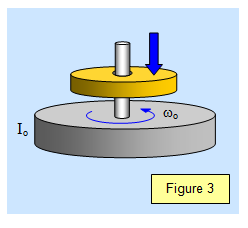
If a disc of moment of inertia I1 is dropped coaxially on to a freely
rotating table of known moment of inertia Io and angular velocity wo (Figure 3) then:
momentum of system before disc is
dropped = momentum of system after disc is dropped
Ioωo = (Io + I1)ω1
where ω1 is
the angular velocity after the disc has been dropped onto the rotating table.
This is
thus a very simple method of determining I1, the moment of inertia of the
disc.
If a disc is dropped onto a table that is maintained at a constant angular
velocity (such as a record deck) then a frictional couple must act to accelerate the disc. The
energy while the disc is accelerating goes both to accelerate the disc and to maintain the
constant velocity of the table.