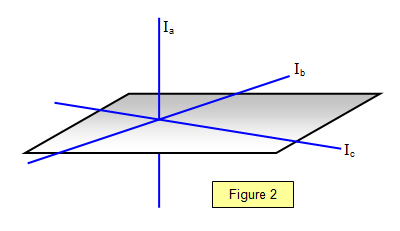

The moment of inertia I of a body about any axis is equal to the moment of inertia IG about a parallel axis through the centre of gravity of the body plus Mb2, where M is the mass of the body and b is the distance between the two axes. (See Figure 1)
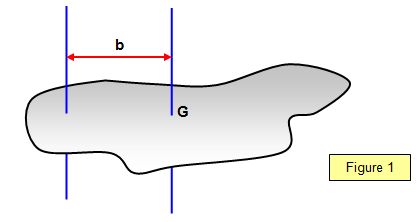
For any plane body (e.g. a rectangular sheet of metal) the moment
of inertia about any axis perpendicular to the plane is equal to the sum of the
moments of inertia about any two perpendicular axes in the plane of the body which
intersect the first axis in the plane.
This theorem is most useful when
considering a body which is of regular form (symmetrical) about two out of the three
axes. If the moment of inertia about these axes is known then that about the third
axis may be calculated.