The floating cylinder
Consider a cylinder of length L and density
r floating in a liquid of density
s. Let the
cylinder have a cross-sectional area A and let a length h be below the surface when the
cylinder is at rest. (See Figure 1)
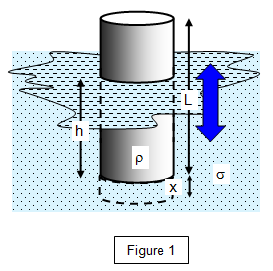
The cylinder is now pushed downwards a little (x) and allowed to
bob up and down, the forces causing the oscillation being gravity and the varying upthrust on
the cylinder.
Extra upthrust = extra weight of liquid displaced = Aσgx
Therefore restoring force = Aσgx = ma
Acceleration (a) = - Aσgx/m = - Aσgx/AρL = - [σg/ρL]x
The acceleration is therefore directly proportional to the
displacement (x) and so the cylinder therefore moves with simple harmonic motion.
The
value of ω
2 for this system is σg/ρL
so the period T is:
Period of floating cylinder (T) = 2π/ω = 2π(h/g)1/2
since for a floating body the upthrust = the weight of the body, that is, ALρ= Ahσ.
A VERSION IN WORD IS AVAILABLE ON THE SCHOOLPHYSICS USB