

The period of a body undergoing simple
harmonic motion can be shown to be independent of the amplitude of the motion.
We
will start by assuming an equation for T that depends on the force on the body F, its
displacement x and its mass m. This can be written as:
T =
KFpxqmr where K is a constant. Using the method of
dimensions to solve for p, q and r
T = K(mx/F)
and therefore if the period is to
be independent of amplitude then x/F must be a constant.
Therefore x is proportional to
F, and since m is constant x is proportional to the acceleration. This is the definition of simple
harmonic motion.
Therefore for s.h.m. the period is independent of the amplitude,
providing that the motion is not damped (see below). This motion is also known as
isochronous motion.
If the displacement at a time t is x1, then
x1 is given by the formula
x1 = r sin θt
and the displacement at a time (t + 2p/θ) is x2, where
x2 = rsinθ(t + 2π/q) = rsin (θt + 2π) = r sin θt cos 2p +r cos θt sin 2π = r sin θt = x1
That is, the motion
repeats itself after a time T where T = 2π/q, and T is therefore the period of the motion:
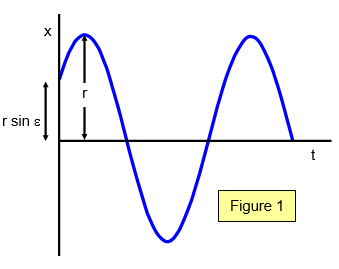
In both these proofs we have assumed that timing was started when the displacement of the body was zero, that is, that t = 0 when x = 0. If this is not the case then we have to introduce a phase shift (e) into the equations giving: