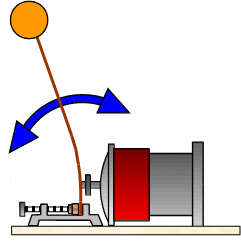


When a child on a swing is being pushed the
amplitude of the oscillation increases rapidly only if the person pushing the swing does so in
time with the natural period of the swing. This effect is called RESONANCE. It can be a
real problem in building design if the frequency of swirls of air have the same frequency as
part of the structure! The building oscillates with increasing amplitude and can eventually
break up! Annoying buzzes can be produced in a concert hall if pieces of equipment such
as fans fixed to the ceiling resonate when a note is played by the orchestra. Resonance can
also be a problem when a car driving mirror vibrates as the car is being driven over an
uneven road at a particular speed.
Resonance occurs in a vibrating system when a
driving frequency is applied to the system which has the same frequency as the fundamental
frequency of the oscillating object (or a simple multiple of it).
Resonance plays a
very important part in the design of a musical instrument like a violin where the body of the
instrument must resonate at a series of different frequencies, these frequencies being slightly
different for each violin. This is made possible by the complex shape of the body and the
material of which the violin is made. The wooden bars at the top of a marimba are made to
have the same resonant frequency as the tubes hanging from them so that the air in the tubes
resonates when the bars are struck.
Resonance is also essential in the tuning of a
radio. The tuning circuit is varied so that its frequency is equal to that of the station you want to
listen to - the signal fed to the amplifier is then large.
Any system usually resonates
not at ONE frequency but over a small range of frequencies. The width of this range
depends on the system itself.