Proof of the formulae for s.h.m. (1)
There are two alternative proofs. We
will give the mathematical one first because it is the more satisfactory of the two.
Simple
harmonic motion is defined by the equation: acceleration = -ω
2x or dv/dt = -ω
2x
Therefore: v dv/dx = - ω
2x and when integrated this becomes
v
2/2 = -ω
2x
2/2 + C
Using the limits
V = 0 when x = r, and v = rω when x = 0, gives C = ω
2r
2/2.
Therefore:
Velocity (v) = +/-ω(r2 – x2)1/2
Note the +/- sign, showing that the velocity
can be in either direction about the midpoint.
Therefore v = dx/dt
= +/- ωv (r
2 – x
2) which when integrated
becomes
Displacement (x) = r sin(ωt)
with the limits x =
+/- r when t = π/2ω or 3π/2ω and x = 0 when t = 0, π/ω or 2θ/ω
Proof of the formulae for s.h.m. (2)
The
next proof is slightly less mathematical, and uses the projection on a diameter of a circle of the
motion of a point P round the circle. Let the velocity of the particle round that circle be U and the
velocity of the projection on AB be v (Figure 1). We wish to show that the motion of the
projection of P on AB is s.h.m.
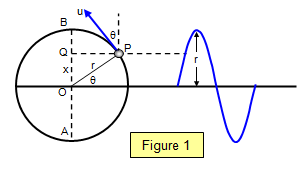
The
displacement (x) of the projection of P from O along AB is given by
x = r sinθ =
r sin ωt
Consider the component of velocity of P parallel
to AB: this will be the velocity of the projection of P on AB.
Component parallel to AB = u
cos ωt = rω cos ωt = rω(1 – sin
2ωt)
1/2 = rω(1-x
2/r
2)
1/2.
Therefore:
Velocity (v) = +/-ω(r2 – x2)1/2
Now the acceleration of P will be towards the
centre of the circle and therefore its component parallel to AB will be:
acceleration = -ω
2r sin ωt = -
ω
2x
This is s.h.m., since we have shown that the
acceleration of Q is directed towards O and proportional to OQ.

schoolphysics SHM and circular motion
To see an animation of the connection between shm and circular motion click on the animation link.
A VERSION IN WORD IS AVAILABLE ON THE SCHOOLPHYSICS CD