
Life as we know it would he very strange without
friction. Friction is useful in brakes - indeed, without the frictional force between our feet and
the ground we could not walk! Frictional forces play a large part in the losses of energy from
machinery and in this area great efforts have been made to reduce them. Guillaume
Amontons first established that there existed a proportional relationship between friction
force and the force between the bodies in contact. Amontons' paper 'De la résistance
causée dans les machines' was published in 1699 in Memoires de l'Académie des Sciences.
To move one body over another which is at rest requires a force. This is needed
both to change the momentum of the first body and also to overcome the frictional force
between the two surfaces. The force needed to overcome the frictional force when the
bodies are at rest is called the limiting friction.
By experiment it has been found that the
limiting frictional force between two surfaces depends on
(a) the nature of the two
surfaces, and
(b) the normal reaction between them. This can be expressed as an
equation as
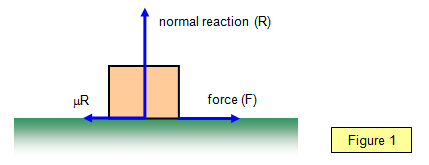
frictional force (F) = coefficient of friction (μ) x normal reaction (R) (Figure 1)
The coefficient of friction depends on both surfaces.
When the object is moving the friction between the two surfaces is usually
less than the limiting friction. It is known as the coefficient of kinetic friction and is almost
independent of the relative velocities of the two surfaces.
Coefficients of friction:
| Materials | Static | Kinetic |
| Steel on steel | 0.74 | 0.57 |
| Aluminium on steel | 0.61 | 0.47 |
| Copper on steel | 0.53 | 0.36 |
| Brass on steel | 0.51 | 0.44 |
| Zinc on cast iron | 0.85 | 0.21 |
| Copper on cast iron | 0.29 | |
| Glass on glass | 0.94 | 0.4 |
| Copper on glass | 0.68 | 0.53 |
| Teflon on teflon | 0.04 | 0.04 |
| Teflon on steel | 0.04 | 0.04 |
| Steel on air | 0.001 | 0.001 |
| Rubber on dry concrete | 1.0 | 0.8 |
| Rubber on wet concrete | 0.3 | 0.25 |
| Steel on ice | 0.03 | |
| Tendon and sheath | 0.013 | 0.8 |
| Lubricated bone joint | 0.001 | 0.003 |
| Wood on wood | 0.3 | |
| Waxed wood on dry snow | 0.4 | |
| Waxed wood on wet snow | 0.1 |
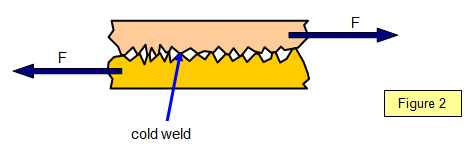
At the points of contact the surfaces are actually
cold-welded' together and it requires energy to break the welds.
The motion of the
top surface over the other is a stick-slip movement: the small projections have to be broken
as the object moves.
The friction between a rubber tyre and the surface of a road is
of considerable importance in safety. In normal use the tyres have a tread to allow the
passage of water but in dry racing-car tyres, the so-called 'slicks', the tyre is perfectly
smooth and relies on the heat generated due to friction to melt a little of the tyre and so
increase the road-holding ability.