

The possibility of producing large
amounts of energy from nuclear fission lead to the construction of the worlds first nuclear
reactor in a squash court in Chicago in 1942. Since then many commercial nuclear power
stations have been built around the world. The neutrons produced in a chain reaction are
moving too fast to cause further fission in U235 nuclei and they have to be slowed down. This
is done by graphite or heavy water and these materials are called moderators. As the
neutrons collide with atoms of the moderator they slow down from 106 ms-1 to 104 ms-1 and at
this speed they are known as thermal neutrons. Rods of boron steel are used as control
rods to control the rate of the reaction since they gobble up neutrons without fissioning.
Lowering them into the reactor core will slow down the reaction. They are held on
electromagnetic clamps so that if there is a dangerous increase in core temperature they can
be dropped into the reactor and so shut down the chain reaction.
A nuclear reactor,
in fact any device using a nuclear chain reaction needs a minimum amount of fuel called the
critical mass (about 15 kg for pure U 235). This is the mass of pure uranium 235 needed to
sustain a chain reaction. Anything less than this and the loss of neutrons from the surface
will be too great and the chain reaction will stop. Masses below this are called subcritical
while those greater than this are known as supercritical. The exact value of the mass
needed depends on the shape and purity of the sample as well as the material.
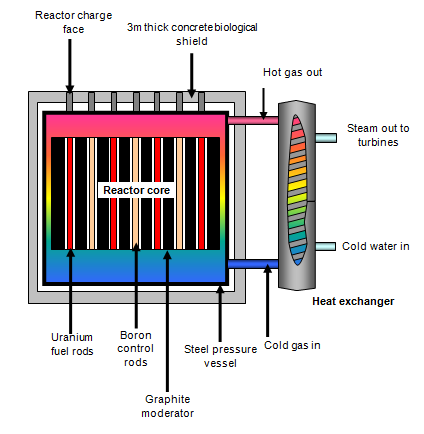
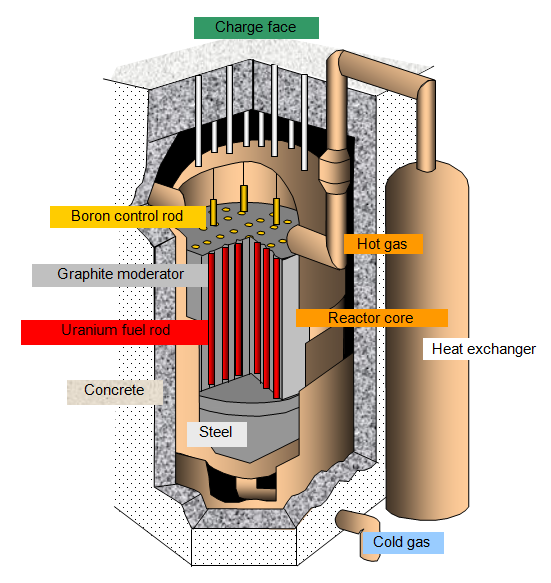
A typical reactor of this type was
built at Hinkley Point in Somerset in 1965, it is now called Hinkley A.
There are two
reactors, each reactor core contains 355x103 kg of uranium fuel (99.3% U238, 0.7% U235) in
36 000 fuel rods, each one a metre long, packed in magnesium alloy (magnox) cans, placed
eight high in 4500 channels in the 1891 tonnes of graphite moderator. The magnesium alloy is
used because it has a low neutron absorption. The core (14m high and 8 m diameter) is
contained in a 20m diameter, 7.62 cm thick steel pressure vessel and heat is drawn off by
carbon dioxide gas at 1.28x10⁶ Pa(185 p.s.i) which is blown through the core. The
temperature of this gas rises from 180oC to 360o as it passes through the core. This is used to
turn water into steam in heat exchangers and the steam drives turbines giving an output of
215 MW of electrical power to the national grid.
(many of these older reactors are being
decommissioned).
This has a pressure vessel 18.9m diameter, 19m high, made of 5m thick
pre-stressed concrete lined with 16mm steel containing a core that gives 1500 MW of power
output.
The fuel is 114.2 x 10³ kg of slightly enriched uranium oxide in fuel elements placed
eight high in 308 channels in the 1384 metric tons of graphite moderator. The coolant is
still carbon dioxide but this time it is blown through the core at a greater pressure (3.97x10⁶
Pa (576 p.s.i)) and with a flow rate of 3790 kgs-1.
The inlet temperature of the gas is 284oC
and this rises to an outlet temperature of 630oC when it leaves the core.
| Type | Fuel (%U235) | Moderator | Coolant | Temperature (oC | Efficiency (%) | Pressure (psi) |
| Magnox | 0.7 | graphite | carbon dioxide | 400 | 31 | 300 |
| AGR | 2.3 | graphite | carbon dioxide | 650 | 42 | 600 |
| PWR | 3.2 | water | water | 324 | 32 | 2250 |
| Fast | 20 Pu | none | sodium | 620 | 44 | 5 |
| BWR | 2.6 | water | water | 386 | 32 | 1050 |
| RBMK | 2 | water | water | 284 | 31 | 1000 |
| SGHWR | 2.24 | heavy water | water | 272 | 32 | 900 |
| Isotope | Low level waste (Bq) | High level waste (Bq) |
| Hydrogen 3 | 0.3x10¹⁴ | 6.8x10¹⁵ |
| Carbon 14 | 4.8x10¹³ | 6.6x10¹⁵ |
| Calcium 41 | 5.8x10¹¹ | 1.3x10¹² |
| Cobalt 60 | 3.7x10¹³ | 2.9x10¹⁸ |
| Nickel 59 | 6.0x10¹⁰ | 2.9x10¹⁸ |
| Caesium 137 | 2.9x10¹³ | 2.3x10¹⁸ |
| Thorium 232 | 3.7x10⁹ | 3.0x10¹² |
| Uranium 238 | 2.5x10¹³ | 2.0x10¹⁴ |
| Plutonium 239 | 2.9x10¹² | 1.7x10¹⁶ |
| Americium 241 | 2.8x10¹² | 5.0x10¹⁶ |
The most radioactive is the high level waste (HLW), and the government has decided to
store it for 50 years before it is disposed of. HLW is the responsibility of UKAEA and BNFL and
is mainly irradiated fuel taken from reactors. Fuel has been reprocessed to take out uranium
and plutonium but it still leaves a very toxic waste behind. This is being converted into glass
blocks for storage. Typically 1000 times more radioactive than ILW, about 100 cubic metres of
HLW is produced every year.
Nuclear power and the Greenhouse effect - it has been
calculated that if nuclear power were expanded CO2 emissions could be reduced by
up to 30%, thus lowering global warming by
15%.