
As early as
1961 a paper appeared in Discovery magazine by Professor EHS Burhop of University College London
suggesting that protons and neutrons were in fact not fundamental particles but that they had a structure.
In 1964 Murray Gell-Mann and George Zweig proposed that all hadrons (mesons and baryons) were
composed of particles that they called QUARKS.
These were finally discovered in 1975 and at
the present time (2002) are thought to be the fundamental particles of matter. One of the most unusual
properties of quarks is that they have fractional electric charge compared with the charge on the electron
of -e.
Their existence was confirmed by high energy electron scattering from the
nucleons.
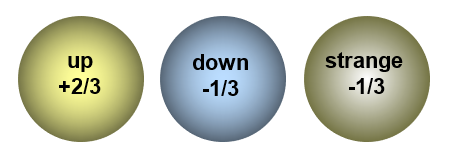
| Quark | Symbol | Charge | Baryon number | Strangeness |
| Up | u | +2/3 | 1/3 | 0 |
| Down | u | -1/3 | 1/3 | 0 |
| Strange | s | -1/3 | 1/3 | -1 |
Quarks are held together to form larger
particles by the strong force produced by the exchange of gluons between them. For example, it was found that protons and neutrons are formed by three
quarks. It has proved very difficult if not impossible to obtain an isolated quark. As
you try to pull them out of the proton or neutron it gets more and more difficult. Even stranger is
the suggestion that if you could pull a quark out of a proton it would immediately form a quark-
antiquark pair and leave you with a quark inside the proton and nothing outside – status
quo!
The reason that it is impossible to get a quark "on its own" is because as you try to
separate them from each other the energy needed gets greater and greater. In fact when they
"break apart" the energy is sufficient to create two new antiquarks and these join to form pions
and so the quarks "disappear"!
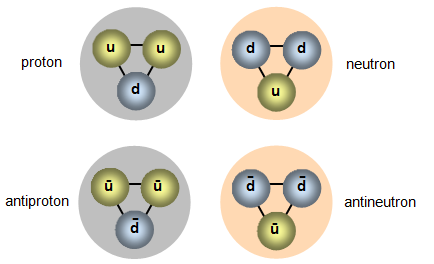
| Proton | uud | Charge = +2/3 +2/3 -1/3 = +1 |
| Neutron | udd | Charge = +2/3 -1/3 -1/3 = 0 |
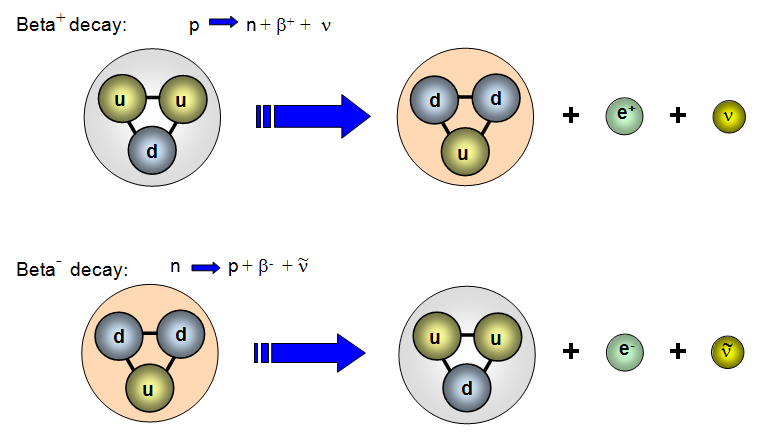
| Beta plus (proton decay) | uud | becomes | ddu |
| Beta minus (neutron decay) | ddu | becomes | uud |
The quarks are held together in the nucleus by the strong nuclear force. This acts only over a very short range, around 10- 15 m and is also responsible for holding the neutrons and protons together in the nucleus. It is thought that the force is carried by the exchange of virtual particles called gluons! These are allowed to appear and disappear as long as they do not violate Heisenberg's uncertainty principle.
This means that the particle can exist for a time
of Δt as long as its energy is no greater than (h/2π)/Δt or more usefully it can have an
energy of ΔE as long as it exists for less than (h/2π)/ΔE where h is Plank's constant
(6.64x10⁻³⁴ Js).
Additional note – mesons and baryons
Baryons are
composed of three quarks while mesons are composed of two quarks. One of the
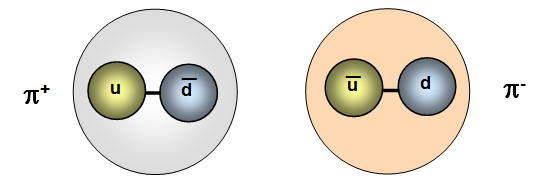
quarks in any meson is an anti-quark. For example a π+
meson is composed of one up quark and one anti-down
quark.