

From measurements of their charge-to-mass ratio Becquerel showed that beta particles were in fact electrons, but relativistic effects have to be taken into account in the measurement, as some beta particles are emitted with 90 % of the velocity of light. It can be shown from the special theory of relativity that at this velocity their mass is about 2.4 times their rest mass. How electrons come to be emitted from the nucleus of an atom will be considered below.
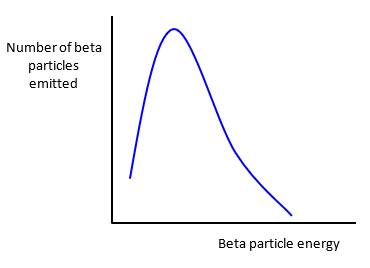
If we record an energy spectrum of the beta particles emitted from a radioactive source, it is found that they have a range of energies between about zero and a maximum. The reason is that the beta particles come from the decay of a neutron into a proton and an electron and also a very light particle called an anti-neutrino:
The variation in beta-particle energy arises from the way in which the energy is shared out between these three products: sometimes more energy goes to the electron and sometimes more to the neutrino.