

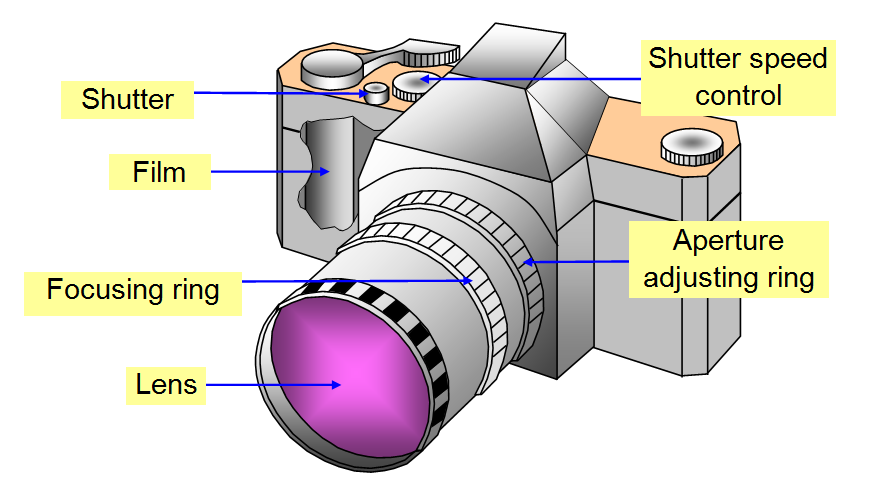
In its simplest form the camera uses a single convex lens to form a real inverted image on a film. The film is coated with a light-sensitive material such as an emulsion of silver bromide on a transparent or paper base. Figure 1 is a diagram of a simple camera.
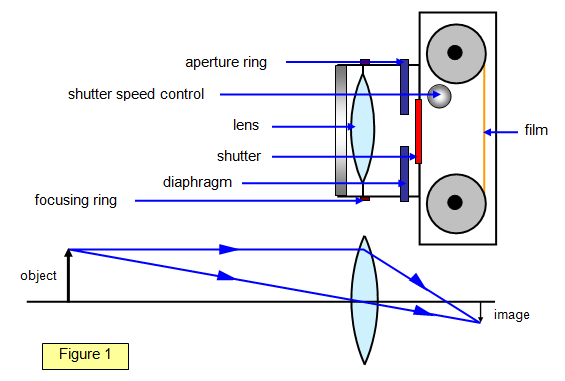
The
important parts of the camera are:
(a) the lens that produces the image,
(b) the
shutter that controls the time for which light is incident on the film (this time may vary from a
thousandth of a second to a few seconds), and
(c) the diaphragm (Figure 2) which
controls the amount of light falling on to the film per second by using more or less of the
aperture of the lens. The aperture of the camera lens is usually described by the f-number or
relative aperture which is defined as follows:
| f number | 2 | 2.8 | 4 | 5.6 | 8 | 11 | 16 | 22 | 32 |
| square of f number | 4 | 7.8 | 16 | 31.4 | 64 | 121 | 256 | 484 | 1024 |

The reason for
this rather curious series of f-numbers is that the square of each is approximately double that
of the previous one. Therefore changing from one to the next will double the aperture of the
camera (since the area of the lens is proportional to the square of its
diameter).
An important property of a camera is its depth of focus, this is
the distance that the film can be moved without spoiling the image. This will correspond to a
depth of field, which is the range of object distance that will still give a satisfactory image.
This is greater for a lens with a short focal length and for larger f-numbers. The depth of
focus can be improved by putting a 'stop' over the front of the lens and then reducing the
size of the hole in the centre of the stop so that only a small part of in the centre of the lens
is used.
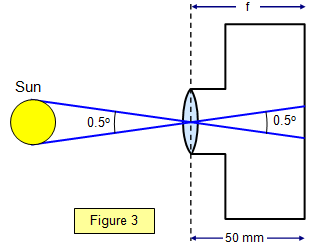 Calculate the diameter of an image of the Sun formed by a camera with a lens of focal length 50 mm if the angular diameter of the Sun when seen from the Earth is 0.5o.